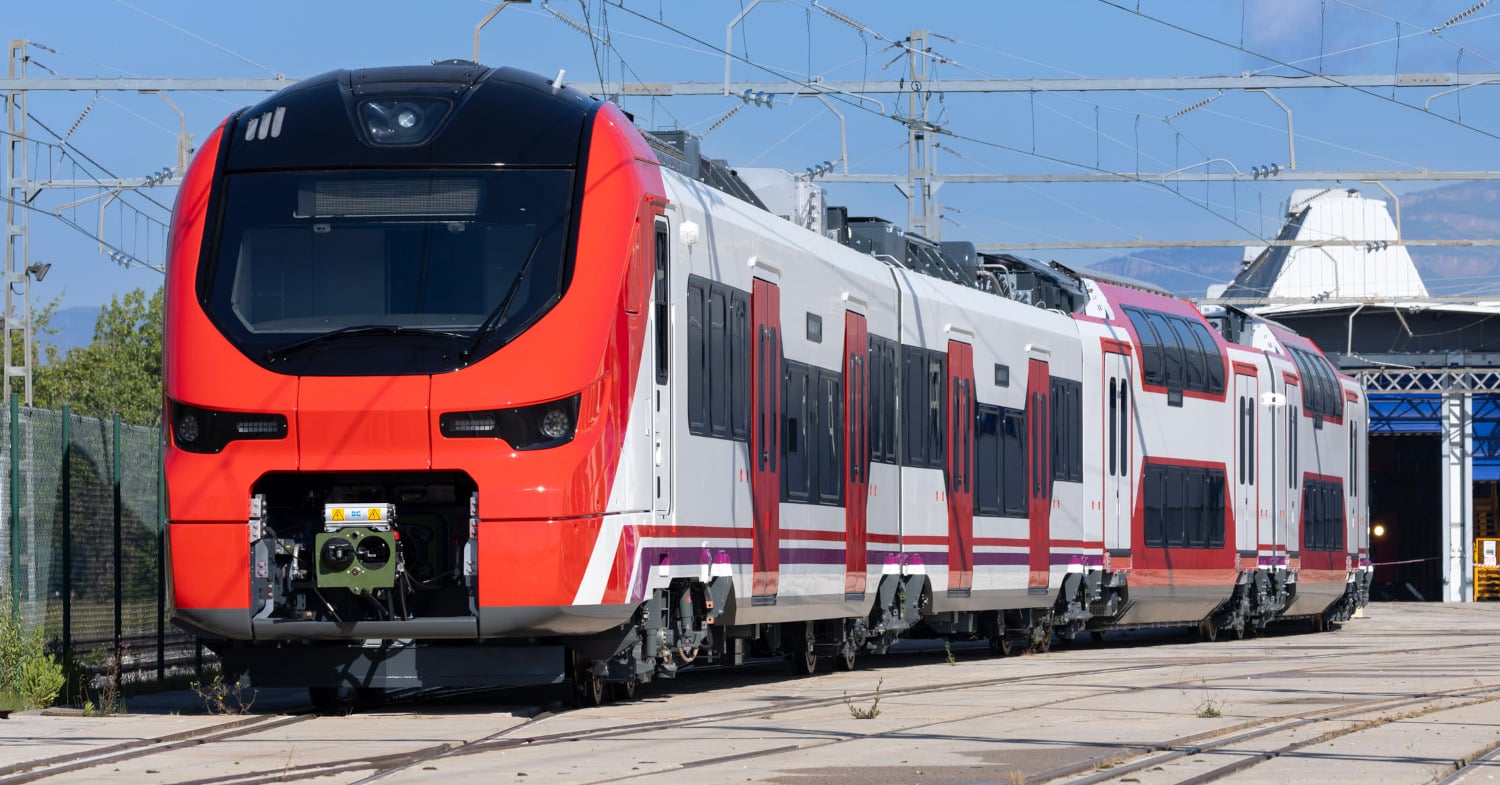
The Spanish State Railway Safety Agency (AESF) authorised Renfe’s Class 452 on 17 November, as now recorded in the European Register of Authorised Types of Vehicles (ERATV). Alstom’s high-capacity trains, intended primarily for Rodalies de Catalunya, have therefore cleared one of the main obstacles to starting deliveries. The authorisation is granted to Renfe Viajeros and applies only to Spain’s Iberian-gauge railway network.
The register lists six vehicle types in the series:

- Driving car C1/C2
- Single-deck intermediate motor car C4
- Single-deck intermediate non-powered car C3
- Double-deck intermediate motor car C5
- Single-deck intermediate trailer car C6
- Double-deck intermediate trailer car C7
All share operating limits. Maximum speed is 140 km/h, the minimum curve radius is 150 m, and up to two formations may be coupled in multiple-unit operation. In workshops and depots, the minimum curve radius is 100 m. The cars may operate only as part of the predefined TL80, TL100 and TL120 formations.
No ERTMS authorisation or TL80/TL120 configurations
Signalling is the main constraint. Alstom has not yet provided evidence of compatibility for the ETCS equipment, so the train cannot operate under ERTMS Level 1. The authorisation cites Article 46.6 of Regulation (EU) 2018/545. The holder must submit that evidence so that the authorisation can be updated and the temporary restriction lifted. On the driving-car record, the train protection system is Indra’s ASFA Digital, without the ASFA RAM or ASFA AV driving modes. Trains may operate only over lines whose balise placement is compatible with the available modes.
Commercial operation is also not authorised in the TL80 and TL120 configurations, nor in multiple-unit operation, except for a formation made up of two TL100s, until those configurations have been validated. However, Renfe has ordered only TL100 formations of six cars.
Because of the restrictions applying to cars C3 and C4, which are fitted with 3 kV pantographs, the trains cannot operate on lines where the contact wire is between 5.5 m and 5.75 m above rail level, as dynamic pantograph behaviour has only been verified on lines with a nominal contact-wire height of 5.3 m.
Among the technical data, the driving car is 20.4 m long, compared with 14.8 m for the intermediate cars. Emergency braking from 140 km/h is completed in around 630 m, with a deceleration of 1.2 m/s². The trains are designed for platforms of 550 mm, 680 mm and 760 mm, although the double-deck cars C5 and C7 are designed only for 680 mm and 760 mm platforms. The fire-safety category is B, and the trains may operate in temperatures ranging from -25 °C to 45 °C.
Delays and train allocation
The authorisation comes after months of delays. Alstom has faced manufacturing and assembly problems, issues with the bogies, and below-expected results in some dynamic and braking tests. The Ministry of Transport’s latest timetable puts the introduction of the first units in spring 2027, compared with deliveries originally scheduled for 2026.
Alstom has received an order from Renfe for 201 trains worth around €1.8 billion, under a contract awarded in 2021 and expanded in 2022. The trains are being built in Santa Perpètua de Mogoda. Renfe has confirmed that it will allocate 72 units to Barcelona and seven to Málaga. Although Madrid will also receive units of this series, it remains to be confirmed whether it will take the remaining 122, or whether any other commuter network will receive these trains.
With authorisation in hand, delivery of the trains to Renfe and driver training can begin. For reference, the Class 453 was authorised on 7 May 2026, driver training began on 21 May, and entry into service took place on 24 August.