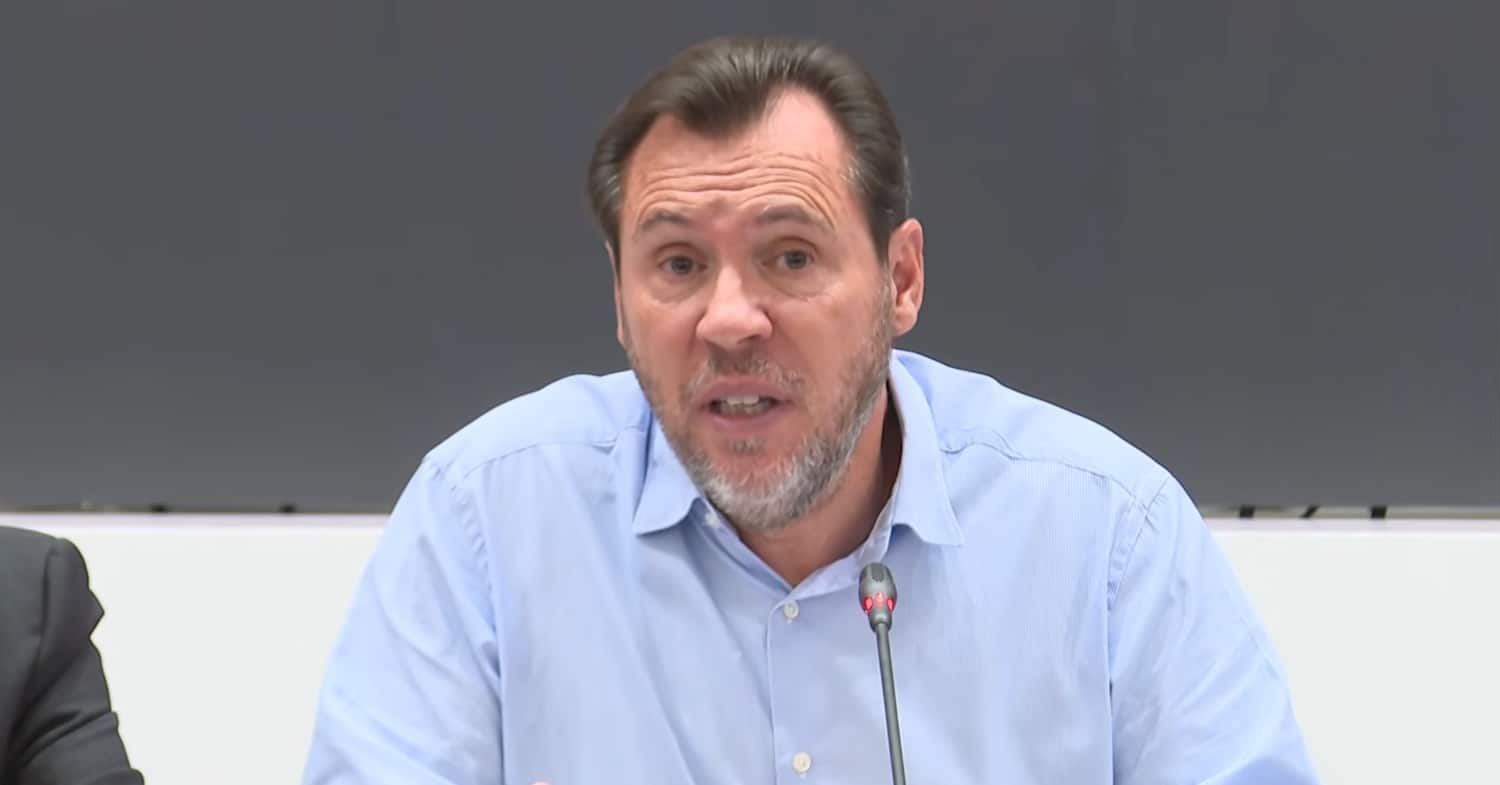
Spain’s Minister for Transport and Sustainable Mobility, Óscar Puente, has held a further media briefing to provide an update on the railway accident at Urda, Toledo.
During his statement, he acknowledged an “error” in decision-making at the Atocha control centre. He explained that, following the loss of LZB, AVE train 2080 was authorised to resume its journey at 08.36, while Iryo train 6076 remained stationary at the station’s home signal at 08.41. The AVE travelled around 25 km and exceeded 160 km/h before colliding with the stationary train at around 08.53.

Puente stressed that the basic rule was clear: if two trains occupy the same block section, the following train must not move; if authorised to proceed, it must do so on sight, at no more than 40 km/h, as far as the next lineside signal. He also emphasised that the train ahead must have started moving and passed the balise marking the block boundary before the following train is allowed to proceed. “No, obviously not, and certainly not if it is in the same block section,” he replied when asked whether the procedure allowed the following train to be authorised to move without confirmation that the train ahead had started moving.
The minister explained that, when Iryo’s train was cleared to depart, the signal changed from red to green and its route was set. When the driver reported that she could not resume the journey, the control centre received that information but took no action. “It is an error. What can I say?” Puente acknowledged, adding that the judicial investigation and the independent accident investigation authority, which issued its initial report yesterday, would have to establish the precise causes.
Technical failure at Urda’s LZB centre
The incident originated at 08.31, when a communications problem arose between the LZB system and the trains. The Urda LZB centre has three computers and a communications module. According to the minister, two of the three computers and the module failed. Maintenance staff based at the same facility responded in less than five minutes and were on site by 08.35. At 08.37, they restored the transmission module, but were unable to recover the two failed computers.
Puente explained that supervisors and control room managers attempted to restore operation using the sole remaining computer, but did not have time to complete the process before the accident occurred. Afterwards, access to the site was restricted by court order, preventing staff from entering to examine the equipment.
The minister ruled out any connection between engineering works and the failure. “Engineering works played no part whatsoever in causing this accident because no works were under way,” he said. According to Puente, the failure resulted from a synchronisation problem between the computers, which detected that the information they were transmitting did not fully match and shut down the system.
Reviewing the approach to renewals
Puente announced that Spain’s approach of carrying out renewal works while maintaining train services was under review. “I will not hide the fact that this is one of the things we are currently considering,” he said in response to a question from the press. The minister compared Spain’s approach with Germany’s, where line renewals often involve prolonged closures. In Spain, priority is given to maintaining services, with works undertaken at night or during maintenance possessions, which Puente said affected reliability and punctuality, but not safety.
The minister explained that works taking five years to complete during maintenance possessions could be delivered in less than 24 months, or even 12 months under normal conditions, if the line were closed. “It is something we have to consider,” he acknowledged. The renewal of the Madrid–Barcelona line, whose condition he described as leaving “considerable room for improvement”, will be one of the projects requiring a decision on this approach.
Puente said the review was not solely a response to the accident, but also reflected the need to restore passengers’ confidence in the reliability and punctuality of rail services. “The lack of confidence is not just about safety, but also reliability and punctuality,” he explained.
Iryo train could not reset LZB
Puente said he did not know why the Iryo train had been unable to resume its journey. He explained that the driver had reported being unable to reset the LZB equipment, but declined to discuss the details, leaving the matter to the investigation. “For whatever reason, the train was stationary. It could have had a fault. Whatever the reason, the train was stopped,” he stressed.
The minister ruled out a connection between the problem and Iryo’s onboard equipment, although he acknowledged that the company’s CEO had told parliament about difficulties resetting LZB after the system failed. “It is an issue with the onboard equipment Iryo has on those trains, and if they have a problem, they will have to resolve it,” he explained.
Puente insisted that the reason why the train was stationary was irrelevant to the analysis of the accident. “If it has a fault, what do we do? Send a train towards it from behind until it crashes into it because it cannot move?” he asked. “That is unacceptable under any circumstances,” he said.
Green signal and control centre error
Puente explained that, when Iryo’s train was cleared to depart, the signal changed from red to green and the route was communicated. When the driver reported that she could not resume the journey, the traffic control centre (CRC) received that information but took no action. “There was a green signal with a stationary train ahead of it that could not depart for several minutes, preventing the following train from being warned that a train was standing ahead,” he explained.
The minister said the AVE driver did not know what lay ahead or whether the “target zero” condition had been resolved. “The driver does not know whether the other train has already been authorised to proceed and the block section is clear. He does not have that information. The control centre does,” he explained. Puente therefore insisted that responsibility for the decision lay with the control centre, which had all the available information on its screen.
The minister acknowledged that the Iryo driver had suggested that movement should be on sight rather than under normal running conditions, but said that suggestion was not decisive. “Only the control centre knows whether another train is occupying the block section under these conditions,” he said.
Controller had two years’ experience
Puente explained that the traffic controller responsible for the operation had completed all the training required by law and satisfactorily fulfilled all the prescribed training periods. “We have nothing to suggest otherwise,” he said. The controller had two years’ experience in traffic control centres and had been managing the same sector since February this year. “It was a sector he knew well,” he added. The controller is 48 and, according to Puente, was “adequately trained and sufficiently experienced”.
The minister did not clarify whether sufficient staff were available to manage the situation when the LZB failure occurred.
Investigation and political responsibility
Puente explained that the investigation would examine every aspect of the accident, including LZB, decision-making and the procedures followed at the CRC. “The investigation must obviously cover everything, not one individual,” he said. The minister added that responsibility for addressing the controller’s actions no longer lay with the ministry, but with the judicial authorities.
He acknowledged that passengers’ confidence in the railway system had been shaken. “Of course confidence has been shaken. To say otherwise would be to deny the obvious,” he said. Puente explained that he had decided to remain in office to work on solutions that would restore passengers’ confidence. “If I believed that remaining in office was damaging the vision for the country that I believe in, I would have had no hesitation in stepping down,” he said.
The minister ruled out any connection between the Urda accident and the CIAF’s 2024 recommendations concerning an incident at Cuenca. “It was an event of a completely different nature. It involved a train passing a signal at danger with LZB operational. It has no connection with this case,” he explained.
Death of Fátima Báñez
Puente expressed his “utter devastation” at the death of Fátima Báñez. “I have not been able to speak to her husband and daughter, who were there at the scene on the afternoon I arrived. I did speak to Soraya Sáenz de Santamaría, and I can convey that to them, as to the other victims’ families,” he said.
Election campaign
Asked whether his decision not to resign could harm the PSOE during the election campaign, Puente said he had not thought about it over the previous 48 hours. “I have neither the time nor the inclination to think about the election campaign. All I have thought about is what happened, how to understand it, how to establish what happened and how to find solutions to improve things,” he explained.
The minister said his decision to remain in office was not based on electoral considerations, but on the need to work on solutions that would restore passengers’ confidence.