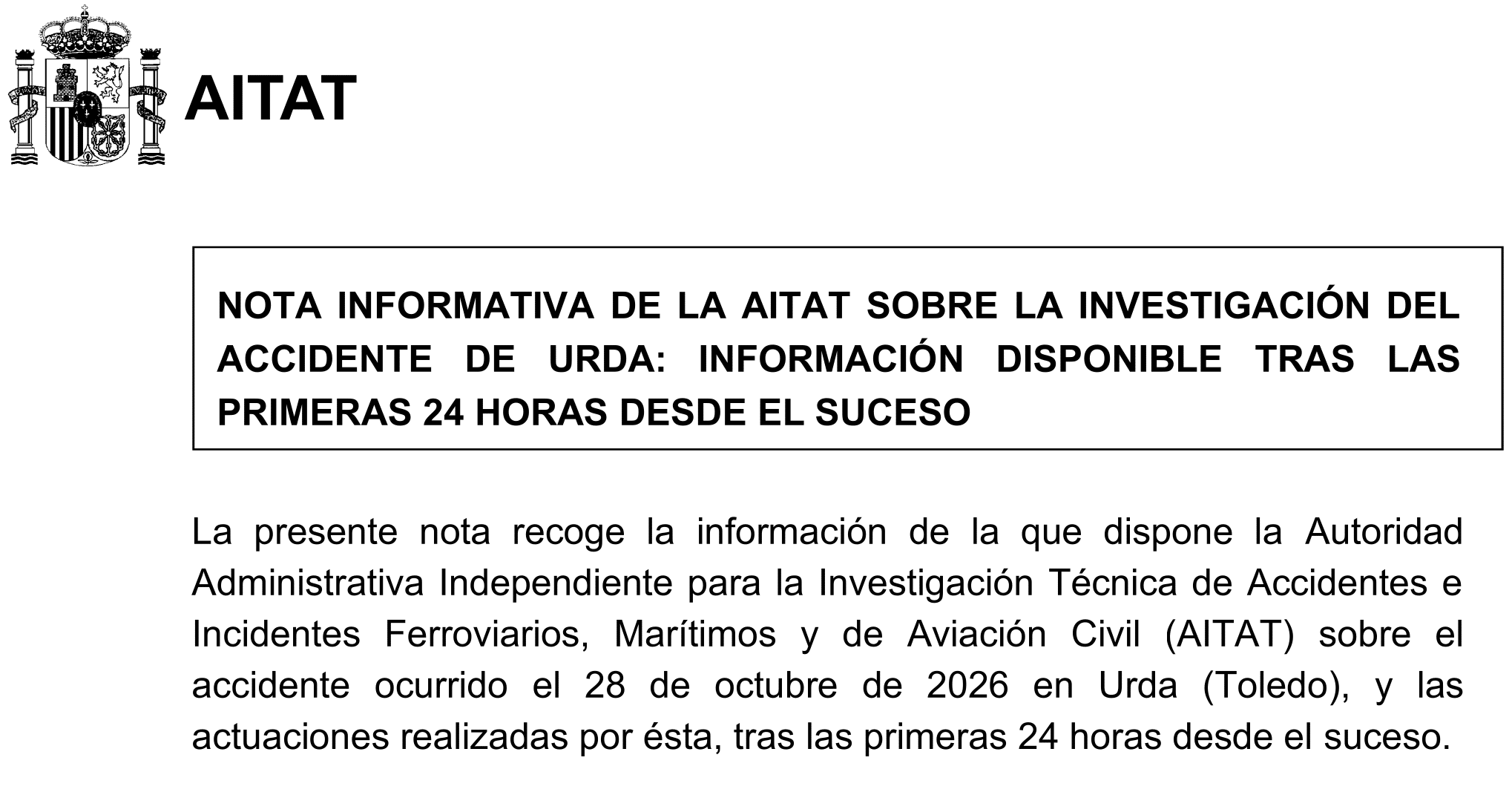
The Independent Administrative Authority for the Technical Investigation of Railway, Maritime and Civil Aviation Accidents and Incidents (AITAT) has published its first information note on the Urda accident. Dated yesterday, 29 October 2026, the document sets out the data available after the first 24 hours. AITAT warns that it contains no definitive conclusions.
Rear-end collision at the approach to Urda
On Wednesday 28 October at 08.53, a rear-end collision occurred at km 118+800 on Line 2 of the Madrid–Sevilla high-speed line (line 010). The location is at the approach to Urda station, in the province of Toledo.

The trains involved were Iryo 6076 Madrid–Sevilla and Renfe Ave 2080 Madrid–Sevilla. The Iryo was an eight-car Hitachi ETR1000 set, number 109-015, carrying 147 passengers and five crew. The Ave was a Siemens set, number 103-006, also of eight cars, with higher loadings: 379 passengers and seven crew.
Set 109 was standing at Urda’s entry signal, E242, when set 103 struck it from behind. AITAT estimates that impact occurred at between 160 and 200 km/h. The exact speed will not be known until data are downloaded from the juridical recorder.
Damage to trains and infrastructure
The leading car of the Ave (car 8) was driven into the rear car of the Iryo (car 1). Both ended up overturned and rotated at the foot of the embankment.
The rest of the Ave derailed completely. Cars 1 to 6 came to rest on the formation, while car 7 fell down the embankment. A section of deformed rail pierced car 3.
On the Iryo, all cars except the two leading ones (7 and 8) derailed. In addition to the rear car, cars 2 and 3 fell down the embankment. The infrastructure was severely damaged and the line remains closed, with no reopening date for now.
The provisional toll at the time of the report’s publication is 69 dead and more than 200 injured to varying degrees. AITAT stresses that the figures are not final and may change.
LZB failure and BSL working
AITAT has gathered information on the degraded situation created by an LZB failure, which began at 08.31. From then on, trains ran under Automatic Block Signalling (BSL, lineside signalling block).
To manage the situation, the Traffic Regulation and Control Centre (CRC) and drivers exchanged information and instructions by telefonemas: written messages sent remotely between the signaller and the driver.
According to the note, the chain of failures, instructions and actions ultimately led to the collision, without the necessary mitigating barriers operating. The investigation will have to analyse the reasons and circumstances, as well as the LZB failures themselves.
It will also examine the environmental, organisational and procedural factors that may have mitigated or aggravated the failures. In doing so it will respond to the call from signallers, who have long denounced their poor working conditions and staff shortages.
Investigators’ actions
AITAT was notified at 09.10. A team of three technicians left Madrid at about 10.20 and reached the site at around 12.15. They inspected the collision point, the infrastructure and the vehicles, made a photographic survey and collected the interlocking event logs at the Local Operations Post (PLO) in Urda.
A second team, comprising the director of railway accident technical investigation and a sector adviser, went to Adif’s high-speed CRC at Atocha. There they reviewed the workstation of the section’s signaller (RC), the telefonema log, video records and recordings of communications prior to the crash.
No drivers or signallers have yet been interviewed, as they were not fit to give statements. Two further investigators joined on Thursday 29, and fieldwork is expected to last at least one more day.
The recorders, both juridical (black boxes) and auxiliary, are in the custody of the Guardia Civil. Data will be downloaded under conditions set by the Court of First Instance of Orgaz (Court No. 2, Civil and Investigating Section), which is leading the judicial inquiry. In some cases, the condition of the vehicles has hampered access to the equipment.
Investigation under way
Given its severity, the event is classed as a serious accident, which requires a technical investigation to be opened immediately under Law 2/2024 of 1 August. AITAT says all hypotheses remain open and that no explanations can be advanced beyond the verified facts.
The final report is expected within one year. AITAT has published on its website the investigation-opening notice and a contact form for those affected. It stresses that its investigations aim solely to improve safety and in no case determine blame or liability.
The authority thanks the emergency services, firefighters, Civil Protection, the UME, the Guardia Civil, Adif-AV, Renfe, Iryo, Actren and Hitachi, and offers its condolences to the victims and their families.