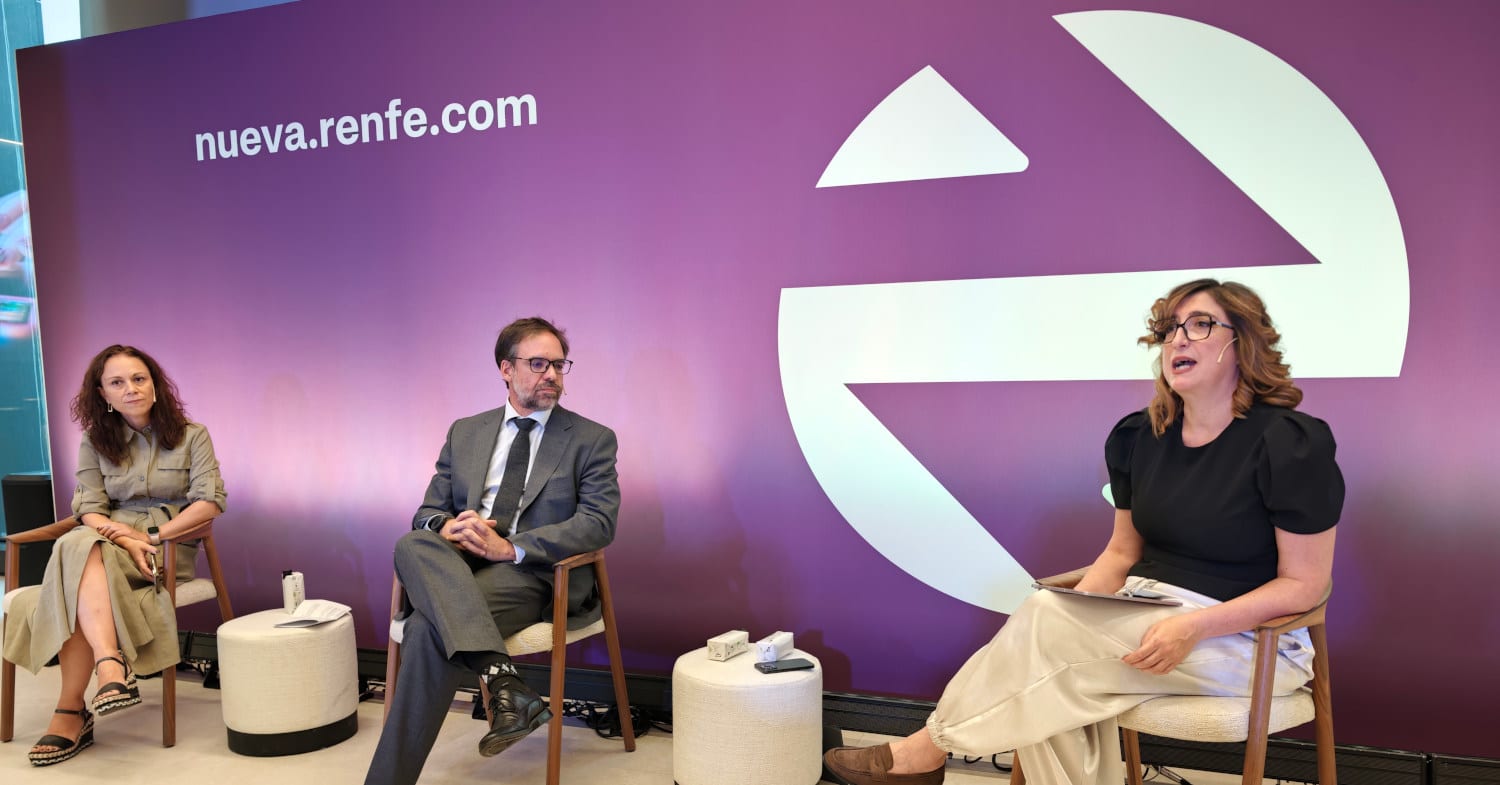
Renfe will launch the first phase of its new ticketing system on 28 October. The new common platform for the operator’s seven sales channels will be introduced progressively until 25 January 2027, according to president Álvaro Fernández Heredia, speaking at an event in Madrid on Monday.
An infrastructure change, not just a website
During the presentation, Fernández Heredia acknowledged that the current system “was not providing the best conditions or the best service” during the purchasing process, particularly through the existing website, which had become “the subject of satire by every comedian in the country”.

The executive explained that the current system is based on almost 400 interconnected applications, many of them programmed in obsolete languages and having been in service for between 20 and 30 years. Renfe has therefore decided to replace the monolithic architecture at its core rather than continue patching it.
Fernández Heredia stressed that the project is not limited to the customer-facing interface. “If it were just a website, it would probably have been perfect and working wonderfully for some time,” he said, insisting that a seemingly simple action such as buying a ticket relies on a complex ecosystem involving numerous information queries and processing operations.
The new ticketing system will operate across the seven physical and digital channels — website, mobile app, ticket offices, ticket vending machines, travel agencies, telephone sales and onboard sales — which will share common criteria for availability, information, sales processes and post-sale ticket management once the system is fully deployed.
Technology partners and project architecture
Renfe has developed the project with two main partners. Siemens is supplying the technological core through its Sqills platform, which, according to Fernández Heredia, is used by 98% of rail operators.
Accenture is acting as systems integrator, adapting the solution to the specific requirements of the Spanish operator. The president also expressly thanked the internal IT teams at both Renfe Operadora and Renfe Viajeros, who have spent months working intensively on the transformation while maintaining the company’s day-to-day operations.
Sonia Segade, Renfe’s director of innovation, customer experience and digital transformation, explained that the development was divided into conceptualisation and progressive construction phases. Functions were tested incrementally rather than being held back for a single launch.
Since May, the system has also been undergoing internal testing with employees in a programme known as “Friends and Family”. Ticket-office staff and commercial personnel are already able to operate the new platform in real-world environments, helping to ensure that it is fully functional and refined before its public launch.
Phased implementation timetable
The entry into service of the new system follows a logic that the company compares with commissioning a new railway line: a period of “shadow operation” before full commercial service begins.
The system will be available on both the website and mobile app from 28 October, coinciding with the anniversary of the inauguration of the Barcelona–Mataró railway. To facilitate the transition, the new system will initially be used to purchase tickets for journeys from 25 January 2027 onwards. From that date, the legacy system will cease operating.
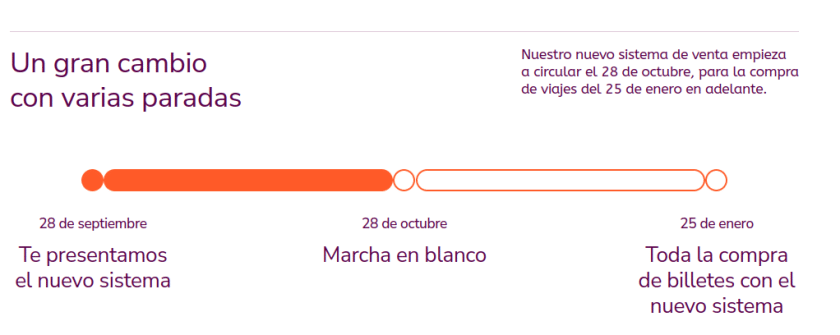
During the transition, journeys before that date will continue to be managed through the existing system. Renfe will maintain a single customer access point, with passengers automatically redirected to the relevant booking environment according to their travel date.
The executives stressed that the dates were not chosen arbitrarily. The timetable is designed to avoid coinciding with the Christmas demand peak. Both systems will operate in parallel for several months, ensuring that no passenger is left without service and that seat inventory remains synchronised between the two platforms.
Investment and project scale
The renewal represents an investment of approximately €158–160 million, according to figures released after the presentation. Around €90 million of this amount relates to Siemens’ contract for the technological core, spread over nine years and linked to the number of tickets sold. It is therefore not a fixed, closed expenditure, but an investment tied to commercial performance.
Accenture’s implementation contract runs for six years and includes not only deployment but also maintenance, cybersecurity and communications services.
Fernández Heredia placed the figure in context: the current system handles more than 95 million queries per month and supports the sale of more than 60 million tickets each year. Its transactional complexity is significantly greater than that of other transport sectors, since every sale requires availability to be checked by coach and by journey section.
Compared with the revenue generated throughout the commercial cycle — sales, post-sale services and management — the executive said that the project represents approximately 1% of that income.
Passenger benefits: fewer steps, greater clarity
The announced improvements include more direct searches, fewer steps and shorter forms. Fare comparisons will also be clearer, showing what each option includes, which changes are permitted and what cancellation conditions apply.
Error messages, one of the most criticised aspects of the current system, will provide understandable explanations allowing users to continue the process without losing information already entered. This is intended to avoid the “highly unpleasant” experience of having to start again after a failure.
Post-sale management will also be strengthened. From the same area where tickets are stored, passengers will be able to view their journeys, amend bookings, change the name of the passenger, request invoices and apply for compensation. The applicable conditions will be displayed more clearly before any transaction is confirmed.
Ancillary services, such as the carriage of pets and bicycles, will be integrated more accessibly into the purchase process. Fernández Heredia summarised the objective with a simple image: being able to “buy a ticket in four clicks” when the passenger already knows their journey.
Accessibility was incorporated from the earliest design stages, with measures to facilitate keyboard navigation, screen-reader use and the comprehension of messages by all types of user.
The validation process included more than 2,000 surveys, 200 interviews and over 50 testing sessions with private and professional users in 18 cities.
Virtual queues and transaction capacity
Asked whether virtual queues could be introduced during demand peaks, similar to those currently seen when buying concert tickets, Sonia Segade explained that the new architecture would allow certain queries — such as timetable searches — to be preloaded without accessing the transactional core each time. This should reduce the load on the central system.
She said that no waiting lists were expected, even during periods of peak demand.
Each purchase currently generates between 10 and 20 internal queries. The new architecture is designed to scale this capacity more flexibly than the existing monolithic system, which can handle peaks of up to 200 tickets per minute.
Last week’s cyberattack
During the question-and-answer session, the executives addressed the cyberattack suffered by Adif several days earlier. The incident resulted in the leakage of Renfe passenger data after several weeks of intrusion attempts which, Fernández Heredia explained, had been repelled until a breach occurred last week.
The company confirmed that personal data had been affected, including email addresses, names and, in some cases, national identity-card numbers. However, it ruled out the compromise of banking data, as Renfe does not store credit-card information on its systems. Segade stressed that passwords are stored in encrypted form.
The incident has been reported to the Spanish Data Protection Agency. Renfe has committed to informing affected passengers individually as the full extent of the attack is established, adding that both the current and new systems comply with applicable security standards.
Travel-agency integration
Regarding the impact on the travel-agency channel, Renfe currently works with approximately 10,000 travel agencies, around 2,000 of which operate as virtual agencies or distribution platforms.
The company has begun a progressive integration process, inviting these partners to work first in pre-production environments and subsequently in production through controlled live-sales testing. The aim is to ensure that the integration is sufficiently robust before the Christmas campaign demand peak, particularly as agencies usually sell tickets an average of three weeks ahead of travel.
Rebranding accompanies the transformation
The presentation coincided with the return of the “biscuit”, Renfe’s historic circular symbol representing a train wheel, as part of a renewal of the brand identity that has been in place for 21 years.
Nacho Padilla, the company’s head of brand design, explained that the logo and corporate purple colour had been retained with a slight variation. The galleta, regarded as part of Spain’s graphic-design heritage, is being given a broader role than it originally occupied.
According to the executives, the visual change is not an isolated redesign but the “packaging” for a wider transformation of the company. This also includes new Cercanías trains and improvements to disruption information. Juan Toribio, designer of the iconic image, attended the presentation.

The return of the “biscuit” is not an isolated change. Renfe is restructuring its entire brand architecture, with new graphic designs planned for AVE and Avlo, alongside a simplification of services.

The brand changes will be announced over the coming weeks and will be accompanied by a new train livery. Although the new AVE logo has been heavily criticised, those who have seen the complete proposal say that it will fit better within the context of the new livery.
In the coming weeks, Renfe also plans to hold a hackathon for developers in November and conduct specific surveys among the first users of the new system. The aim is to gather feedback before 25 January 2027, when the New Ticketing System is scheduled to become fully integrated across the company’s commercial operations.