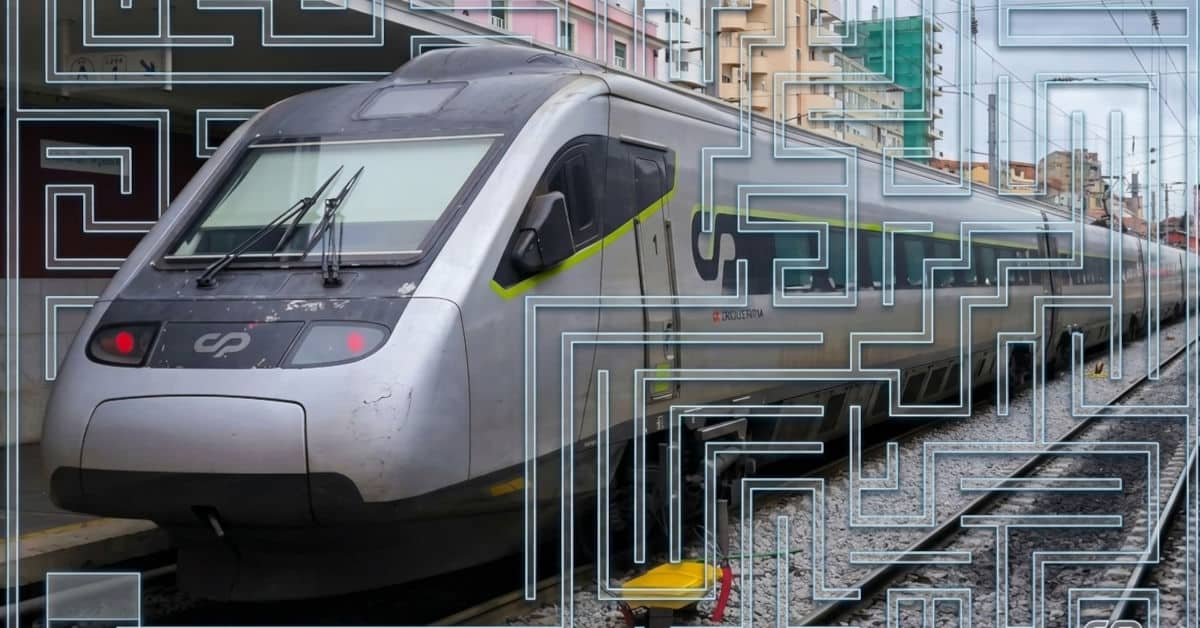
Railway projects are usually slow, but in Portugal they are even slower. The country sees a succession of announcements and public presentations of major rail investments, and there are indeed quite a few sites with work under way. However, projects take a long time to finish, drag on over years (almost always with little explanation from governments) and, when completed, turn out to be little more than low-cost modernisations: there was insufficient will and drive to go further, so trains do not run faster, line capacity has not increased and, in short, the railway has gained almost no competitiveness.
After joining the EEC in 1986, successive governments put roads first. Between 1990 and 2020, Portugal went from 300 to 3,000 km of motorways and dual carriageways, becoming the second country in Europe with the most high-capacity road kilometres per inhabitant, behind only Spain. In this, both Iberian countries met an objective that pleased rulers and ruled alike: the expansion of the road network. New generations of Portuguese and Spanish people were tired of being at the back of Europe, and owning a car alongside a good road network made them feel more… European.

Comparisons between the two countries end there. Spain, in the meantime, built 3,000 km of high-speed lines. Portugal not only failed to invest in railways, but it also allowed its network to deteriorate. After all — so the thinking went — the train was a mode of transport from the past. It was said that “the railway is the transport of the 21st century if it manages to survive the 20th”. It barely did survive. But when, in the early years of this century, political discourse began to change, and the population started demanding a bigger push for rail — driven by road congestion, fuel prices and the need to tackle climate change — the financial crisis, the troika and an emergency brake on rail investment arrived.
Projects and more projects
Even so, the conservative government of Pedro Passos Coelho drew up PETI (the Strategic Plan for Transport and Infrastructure) for 2011–2015, focused essentially on rail freight, sidelining passenger services and ignoring the role of the train in territorial cohesion.
The Socialist government of António Costa, which took office in 2015, chose not to amend the previous plan and rebranded it as Ferrovia 2020. It was presented in 2016 at the headquarters of IP – Infraestruturas de Portugal, the entity responsible for rail infrastructure but which also manages the road network. The plan envisaged €2.7 billion of investment to modernise 979 km of track and build 214 km of new lines.
Things started badly. Of what was to be new construction, the Aveiro–Mangualde line — intended to form part of an Aveiro–Salamanca structural corridor — was dropped immediately because Brussels refused funding due to the project’s negative rate of return. The total planned investment thus fell from €2.7 billion to €2.1 billion.
Ferrovia 2020 was supposed to run between 2016 and 2020, but by the end of that final year most of the 20 planned interventions were still at tender, design or start-of-works stage. To date, only 12 are complete, seven are still underway, and one has not even started.
At stake was the modernisation of the Lisbon–Porto line, the true backbone of the Portuguese rail network, which remains incomplete. The Minho line (Porto–Valença/Tui) was modernised, as were the Guarda–Covilhã line, the Caíde–Marco de Canaveses section (in the Porto metropolitan area) and the Beira Alta line (between Pampilhosa and Vilar Formoso/Fuentes de Oñoro). The Douro line (between Marco de Canaveses and Régua) and the Oeste line (between Meleças and Caldas da Rainha) remain stuck in works that are dragging on and far from completion.
The main project under Ferrovia 2020, however, is the construction of the Évora–Elvas/Badajoz line, which will allow freight from the port of Sines to reach Spain and is designed for 250 km/h speeds so it can be integrated into the future Lisbon–Madrid high-speed line.
In response to successive delays, successive governments and IP – Infraestruturas de Portugal have argued, first, a lack of engineering and know-how on Portuguese soil to move projects forward (the troika had left Portugal without technical cadres due to underinvestment in the sector); then the pandemic and the rupture of supply chains; and, later, the war in Ukraine. All completed projects saw successive announced dates come and go unmet. The most glaring example was the modernisation of the Beira Alta line, closed for works for an expected nine-month period and only reopened three years later.
In most investments, the result has been limited to electrification and the installation of modern electronic signalling and telecommunications systems. Track alignments were not altered, and train speeds did not increase. For passengers, the only novelty was the shift from diesel to electric traction. Journey times remained the same.
In October 2020, António Costa’s government presented the PNI2030 (National Investment Plan), which, for railways, earmarked €970 million across six modernisation projects on six lines. Among them, one of the most notable is the construction of bypasses on the Sul line (the railway crossing the Alentejo to link Lisbon with the Algarve). Another is the continuation of the modernisation of the Douro line, considered one of the most spectacular in the world for running parallel to the river that gives it its name.
However, at present only one of the PNI2030 rail projects is (partially) complete: the renewal of the Vouga line (near Espinho and Aveiro), which is the only metre-gauge line left in Portugal. All other projects have not left the drawing board. Meanwhile, IP – Infraestruturas de Portugal has removed from its website the investment amount for each intervention.
Light at the end of the tunnel
Meanwhile, after 30 years of false starts and U-turns, high-speed rail in Portugal is finally beginning to see light at the end of the tunnel. On 29 July 2025, the construction of the first 71 km section between Porto and Oiã (near Aveiro) was awarded to the LusoLav consortium (led by Mota-Engil and including Teixeira Duarte, Casais, Alves Ribeiro, Conduril and Gabriel Couto). This is the first step in a project to build a vertical high-speed axis to structure the Portuguese coast: Lisbon–Porto–Valença, with a continuation towards Vigo. It is a clear strategic decision by António Costa’s government, now maintained by Luís Montenegro, to prioritise the internal connection before advancing the Lisbon–Madrid line. The latter is under construction only on the Évora–Elvas/Badajoz section; the Lisbon–Elvas section is still missing, including a colossal work: the construction of a third bridge over the Tagus estuary.
The aim of these lines is to connect Lisbon and Porto in 1h15m by 2032, and Porto and Vigo in 30 minutes. The Lisbon–Madrid connection, which should link the two Iberian capitals in 3h15m, is scheduled (on the Portuguese side) for 2034.
The Lisbon–Porto line will cost between €4.5 and €5 billion and will have only three intermediate stops: Leiria, Coimbra and Aveiro. It will be built in Iberian gauge so as not to create an “island” within the Portuguese rail network and to be able to host conventional services with origins and destinations beyond Lisbon and Porto. Moreover, the high-speed approaches currently nearing the Portuguese border are not yet completed in international or standard gauge (1,435 mm). Even so, the Portuguese high-speed line will install multi-gauge sleepers to allow a future switch to the gauge used in the rest of Europe.
These projects fall under the National Railway Plan, a document initiated under António Costa’s government and approved by the current executive in April 2025. The idea has been to elevate to law what, until then, were scattered projects at the mercy of political cycles and PowerPoint presentations by IP – Infraestruturas de Portugal. In broad terms, the plan envisages the recovery of conventional lines, the construction of high-speed rail and a new suburban line between Porto and Felgueiras. One of the plan’s most ambitious projects, though still immature, is the Trás-os-Montes High-Speed Line, which proposes to link Porto with Bragança and Zamora (connecting there with the Madrid–Galicia line). This northern route proposal is a “rival” to another projected in the centre that aims to connect Aveiro with Salamanca (and Madrid). And to the south, another line appears on the map: the Faro–Huelva line.
But the example of this last line is enough to show how paper (or PowerPoints) can bear anything. At the 2003 Iberian Summit in Figueira da Foz, chaired by José María Aznar and Durão Barroso, the Faro–Huelva connection first appeared as a joint project. Twenty years later, at the 2024 Faro Summit, the governments led by Pedro Sánchez and Luís Montenegro reaffirmed their intention to continue carrying out feasibility studies. In March 2026, at the Huelva Summit, the same leaders met again without any of those studies having advanced a single step.
Returning to that 2003 Iberian Summit: Spain undertook to electrify the Salamanca–Fuentes de Oñoro section to give continuity to the Beira Alta line — electrified in 1997 — and thus allow an interoperable rail axis between Portugal and Salamanca, Valladolid, Burgos, San Sebastián and France. To date, those 107 km remain unelectrified, with works proceeding very slowly.