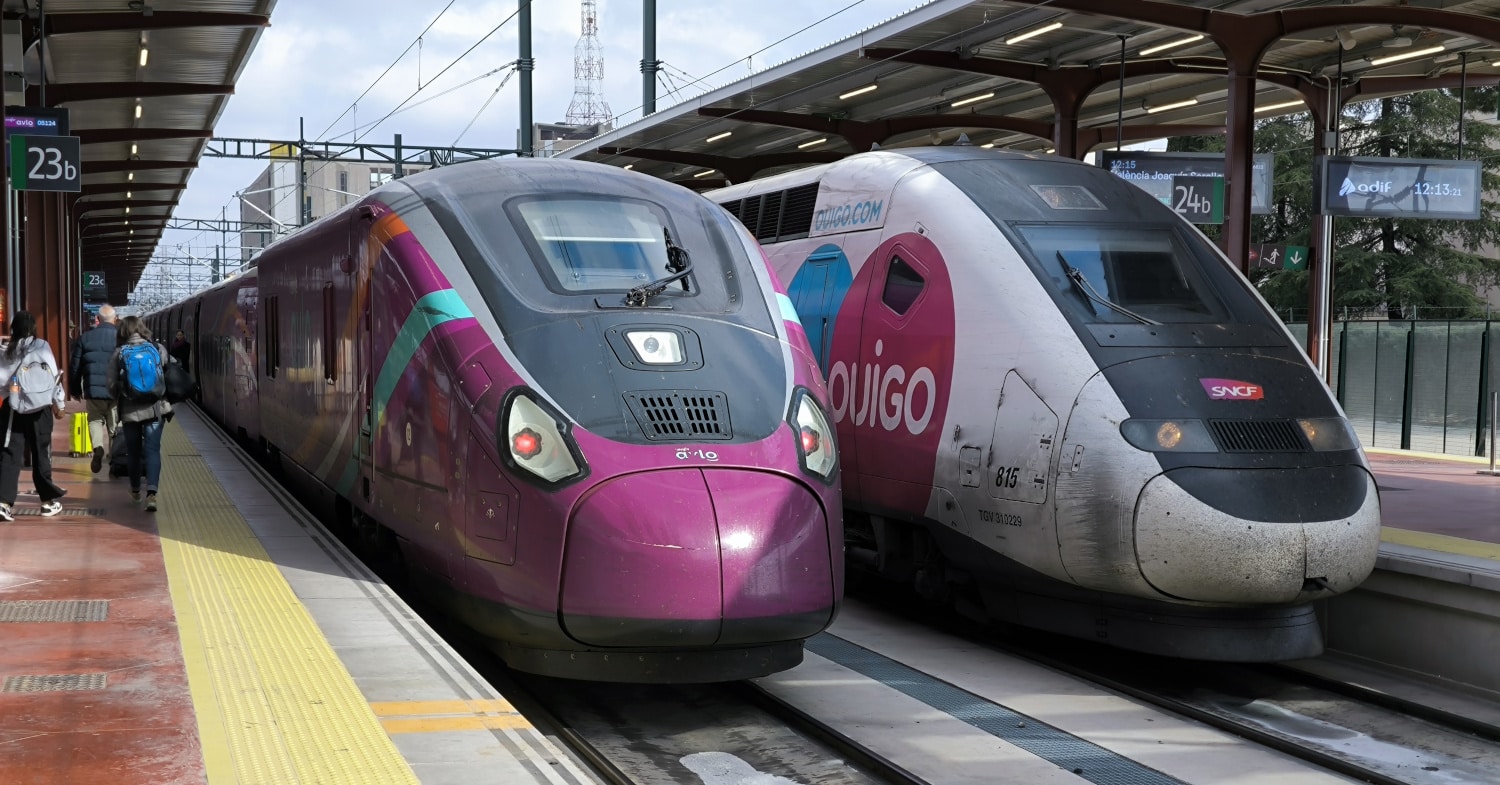
Spain’s National Commission for Markets and Competition (CNMC) has upheld Ouigo’s complaint against the reduction in capacity allocated to it by Renfe Ingeniería y Mantenimiento at its Cerro Negro/Santa Catalina, Can Tunis and Fuencarral maintenance depots. The regulator considers that the decision constitutes a refusal of access and discriminatory treatment in breach of the Railway Sector Act.
Renfe has announced that it will challenge this ruling and other CNMC decisions concerning other operators’ use of its maintenance facilities before Spain’s National Court, the Audiencia Nacional. The state-owned company rejects the classification of the work in question as basic maintenance services and argues that making capacity available will reduce the space available to maintain its own fleet.

The ruling, dated 8 October 2026 and published on Tuesday, requires Renfe to provide access on the terms of the allocation made on 30 January 2025, covering the 2025–2030 period. It also requires Ouigo to provide detailed information on the maintenance activities planned for each train.
Capacity allocation reduced months later
The dispute stems from the multi-year capacity application submitted by Ouigo in August 2024, after Renfe Mantenimiento offered discounts for commitments exceeding one year. According to the case file, the requirements submitted did not differ substantially from those of previous years.
Renfe allocated the capacity on 30 January 2025, but notified Ouigo of a reduction on 26 May, which it confirmed in July. On 14 October, it warned Ouigo that it had 15 days to sign the revised allocation or its application would be deemed withdrawn. The operator referred the dispute to the CNMC on 29 October. Both the volume of capacity allocated and the percentage reduction are redacted as confidential in the ruling.
The disagreement centred on the maintenance activities designated VL, VG and GVG. Renfe Mantenimiento argued that these included heavy maintenance work, such as component removal and reviews of components’ remaining service life, which was incompatible with the use of light maintenance depots.
Faced with this capacity reduction, Ouigo linked the continuation of its services to temporarily retaining its existing maintenance arrangements, as this publication reported when the dispute became public.
Renfe to take the dispute to the National Court
In its response to the ruling, Renfe accuses the CNMC of “abusive conduct” and of changing the interpretation of the legal framework. The company maintains that the activities requested by Ouigo constitute heavy maintenance and that there is therefore no obligation to provide access for them.
The company links this case to another ruling concerning Iryo’s use of facilities in Valladolid. In its view, these decisions shift costs and risks arising from its competitors’ activities onto Renfe and constrain its operating capacity, with consequences for the services it provides.
Renfe also argues that the operators concerned have alternatives, such as building their own depots or undertaking certain activities at facilities in Italy or France. Contrasting this with the investment it says it is making to strengthen its industrial capacity, Renfe accuses these companies of “freeloading” on its facilities rather than investing in Spain.
The announcement of legal action before the National Court signals Renfe’s intention to challenge the regulator’s decisions through the courts. The Ouigo ruling exhausts the administrative appeals process and provides for an application for judicial review to be lodged within two months of notification.
Mandatory access to basic maintenance services
Access to maintenance facilities is subject to different obligations depending on the nature of the services. The Railway Sector Act, underpinned by Directive 2012/34/EU, requires depot operators to provide access to facilities and basic services on a non-discriminatory basis. Heavy maintenance falls within ancillary services, which operators are not obliged to provide. However, if such services are offered to one railway undertaking, they must be made available without discrimination to others requesting them.
Under this framework, access to a depot and the execution of maintenance work are separate activities. Renfe manages facilities used by different operators, while the work itself may be carried out by the company responsible for maintaining the rolling stock, such as Ateinsa in the case of Ouigo’s Class 108 trains.
The question addressed by the CNMC is therefore not whether Renfe must generally open its depots for any type of work, but how to classify the specific activities for which it had reduced Ouigo’s capacity.
Removing a component is not the same as repairing it
The CNMC distinguishes between work undertaken on the train and repairs to components removed from it. At Renfe’s depots, Ouigo removes and refits components using the available equipment, while repairs to those components are carried out at Alstom’s facilities in Pinto. Renfe Mantenimiento did not dispute the latter point during the proceedings.
The regulator classifies the activities in question as maintenance levels 2 and 3 as defined by the European Union Agency for Railways. It therefore concludes that they constitute basic maintenance services subject to access and non-discrimination obligations, rather than ancillary heavy maintenance services, contrary to Renfe’s interpretation.
It also notes that Renfe withdrew capacity for all three maintenance categories, despite identifying only three activities involving brake system checks as heavy maintenance: two within VG and one within GVG. It did not challenge any of the VL activities on those grounds.
Equivalent work for Renfe Viajeros
The ruling also compares Ouigo’s treatment with that of Renfe Viajeros. The CNMC finds that the latter has capacity allocated for 2025–2044 at light maintenance depots for technically equivalent work, in some cases involving longer depot occupancy periods than those requested by Ouigo.
Examples include VL, VG and GVG maintenance on Class 104 trains in Málaga, whose maintenance plan includes reviews of components’ remaining service life equivalent to those envisaged for Ouigo’s rolling stock. In the CNMC’s view, denying this operator access without sufficient objective justification constitutes discriminatory treatment.
During the proceedings, Renfe Mantenimiento also cited safety risks, congestion arising from the use of maintenance roads and the bogie drop, and higher operating costs. The regulator responds that, where requests conflict, the facility operator must seek to co-ordinate them and, if necessary, apply transparent, objective and non-discriminatory priorities, giving precedence to routine activities needed to keep rolling stock immediately available for service.
On costs, the CNMC notes that the regulations allow these to be recovered through service charges, together with a reasonable profit. It also points out that Renfe does not identify the same risks for technically equivalent work undertaken for Renfe Viajeros.
Ouigo required to detail its maintenance programme
The CNMC welcomes Ouigo’s decision to split certain maintenance activities into more frequent, shorter depot visits to optimise maintenance. However, it stresses that Renfe must have sufficient information to manage capacity at its facilities.
Ouigo must therefore provide details of the maintenance activities planned for 2025–2030, broken down by year, category and train, and specify each unit’s maintenance cycle and mileage. This information must enable operators’ requests to be accommodated alongside one another and the use of depots and their equipment to be planned.