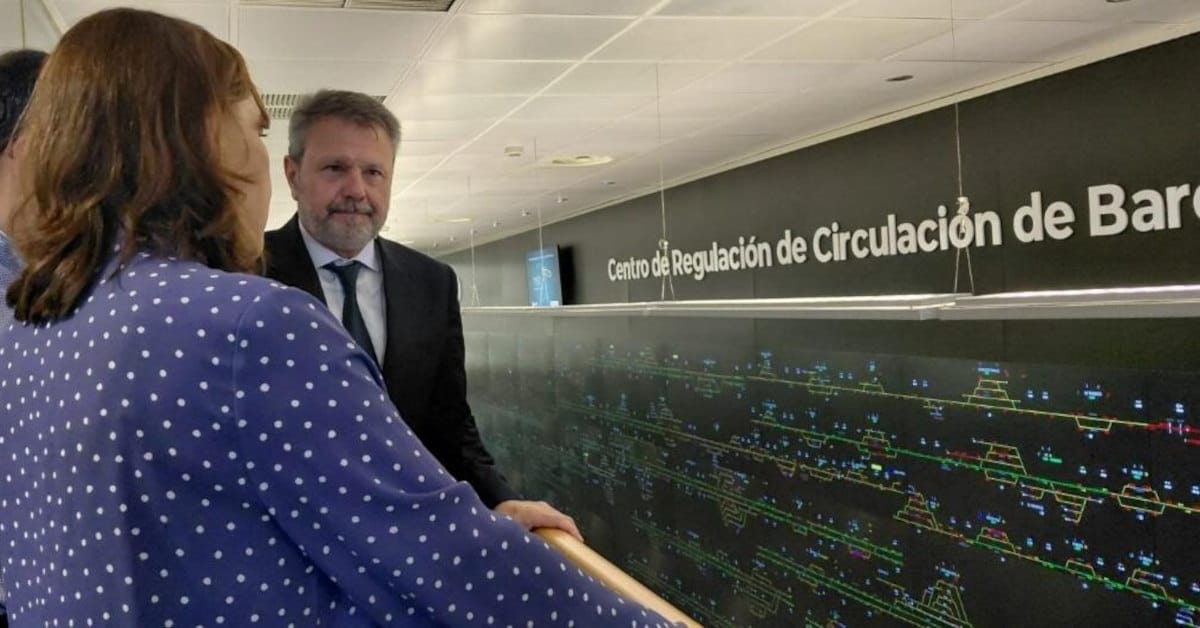
Secretary of State for Transport and Mobility José Antonio Santano used a visit to Adif’s Circulation Control Centre (CRC) at Estació de França to underline the benefits that the deployment of ERTMS (European Rail Traffic Management System) will bring to the Rodalies network, a €280 million scheme framed within the Rodalies Plan.
The CRC visit emphasised that rolling out this equipment will directly improve service quality: added capacity on congested sections, greater reliability in traffic management, and a step-change in safety and communications.

Adif leads Europe in ERTMS deployment, with more than 3,100 route-km in service, and is now transferring this technology—already mature on high-speed lines—to high-capacity suburban networks such as Barcelona’s. On Rodalies, ERTMS Level 2 is being rolled out progressively on several sections, requiring interlockings to be renewed, track-circuit layouts adapted, and integration into the França CRC and its Sants backup centre.
Works under way by line: R1, R2, R4 and key corridors
The most advanced section is L’Hospitalet–Mataró (R1), where Adif has completed construction and internal validation and is preparing documentation to seek commissioning authorisation from AESF.
In parallel, work is progressing on the R4 (Manresa–Sants), with BAB installed between Manresa and Terrassa and new interlockings at Fabra i Puig, while interventions at Sabadell Sud and Cerdanyola are being prepared.
On the R2 (Barcelona–Sant Vicenç de Calders), the Castelldefels interlocking has already been renewed and regulation systems installed at Gavà, El Prat and Bellvitge; Cunit, Vilanova, Sitges and Garraf remain outstanding. Progress is also noted on the L’Hospitalet–Vilafranca–Port Aventura corridor, with projects under way or in procurement on Can Tunis–Mollet, La Sagrera–Granollers and Granollers–Maçanet–Massanes.
How ERTMS Level 2 works and what passengers gain
ERTMS is a safety system that replaces ASFA and Tren-Tierra. It continuously monitors speed and safe braking distance, automatically applying the brakes if the permitted speed is exceeded or a stop signal is passed.
Broadly, it comprises ETCS, which protects the train and supervises speed, and GSM-R, the railway radio network that carries voice and data between track and train. At Level 2, communication is continuous and bidirectional via GSM-R, with a Radio Block Centre (RBC) sending movement authorities and speed limits directly to the cab display.
For passengers, this means greater safety (continuous supervision and emergency braking), higher capacity (reduced headways without doubling track), and improved regularity and punctuality, thanks to simplified field-equipment deployment and a shift to digital, telecommunications-based systems. Adif notes that ERTMS is interoperable across Europe, delivering long-term efficiency and sustainability.
GSM-R: the backbone of communications on Rodalies
ERTMS deployment goes hand in hand with strengthening GSM-R, the railway radiotelephony network that supports point-to-point, group, and emergency calls, and also serves as the data transmission pillar for ERTMS Level 2.
On Rodalies, GSM-R already covers extensive sections—from Molins de Rei to Maçanet-Massanes, including airport access and the line towards Vic-Ripoll—and is now being duplicated or newly installed on key axes such as L’Hospitalet–Mataró, L’Hospitalet–Port Aventura, Manresa–Sants–Vilanova–Sant Vicenç, the new access to El Prat, and Manresa–Lleida.
European funding
The EU funds signalling, fixed telecommunications, and ERTMS Level 2 works on the Hospitalet–Port Aventura and Manresa–Sants–Sant Vicenç sections through the Recovery, Transformation and Resilience Plan (NextGenerationEU).