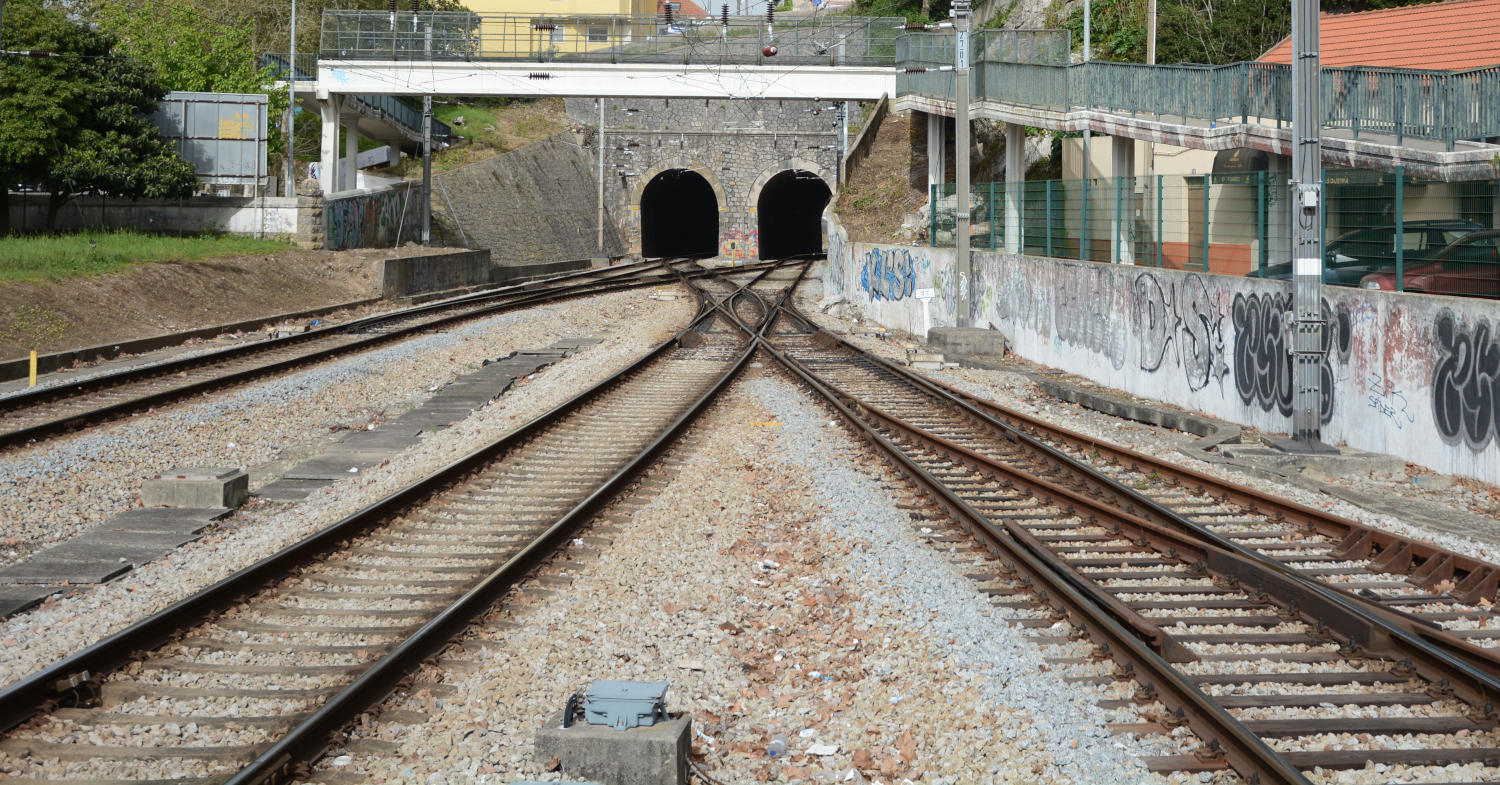
Portugal does not plan to abandon Iberian gauge on its conventional network, at least within the timeframe of the gauge strategy study submitted to Brussels. Infraestruturas de Portugal (IP) considers that migration to 1,435 mm European standard gauge could not be justified under current conditions, given the outlay required, the complexity of the works and the impact on operations over several decades.
The report, delivered to the European Commission’s Directorate-General for Mobility and Transport on 19 July, responds to the obligation set out in Article 17 of the revised Trans-European Transport Network (TEN-T) regulation. Member States with networks that do not use standard gauge were required to identify the sections of TEN-T corridors suitable for conversion and to accompany the analysis with a socioeconomic and interoperability study.

Two scenarios, one verdict
IP has evaluated two options. The first covers the Portuguese section of the Atlantic Corridor, with some 1,500 km linking Sines, Setúbal, Lisbon, Aveiro and Leixões/Porto with the connections to Spain. The second proposes converting virtually the entire national network, close to 2,500 km of 1,668 mm gauge.
The results offer little cause for optimism: adapting the corridor would require between €6bn and €6.5bn, while full conversion would cost between €6.4bn and €6.9bn, figures that include both infrastructure and new rolling stock. In both cases, the works would take between 17 and 30 years.
During this period, IP anticipates frequent closures, capacity restrictions and traffic diversions. The infrastructure manager warns that some passengers and freight could end up switching to road, undermining the competitiveness of rail, logistics and decarbonisation goals. Lisbon and Porto suburban services would be the most exposed.
A dual-gauge network: a cure worse than the disease
Migrating only the Atlantic Corridor also fails to convince IP. Maintaining a split network would require eight transhipment terminals, 17 gauge-changeover facilities and rolling stock capable of running on both gauges. The result would be costlier, more complex operations, without fully resolving interoperability with the rest of Europe.
Full conversion, by contrast, would eliminate in the long term the discontinuities between the historic network and new European infrastructure. However, IP considers that the transition cost, both financial and operational, outweighs that medium-term benefit.
Coordination with Spain, an essential condition
Portugal insists that any eventual decision cannot be taken in isolation. Any migration would have to be agreed with Spain, whose own analysis for the European Commission put the cost of converting its network at €30bn. Otherwise, Portugal would risk creating an island of standard gauge within a peninsula that continues to operate on Iberian gauge.
The Portuguese government had already signalled this position: IP acknowledges that Brussels understands that the change of track gauge must be designed and implemented in direct coordination with Spain, and that prolonged coexistence of both gauges would cause serious difficulties for operators and users.
Ready to change, but no date set
The conclusion does not mean permanently renouncing migration. IP is installing multi-gauge (polyvalent) sleepers on projects such as Évora–Elvas, the Sines line and the Beira Alta upgrades, so that tracks can be converted in future without fully rebuilding the formation.
High-speed rail, however, shows an awkward duality. The Lisbon–Madrid line must adopt European gauge in line with the October 2025 European implementing decision, with coordinated Spanish-Portuguese plans due before the end of 2027 and through services planned for 2034. By contrast, the Porto–Lisbon corridor is being built to Iberian gauge to connect with the existing network from day one, while CP is ordering 1,668 mm trains that can later be adapted to 1,435 mm.
In short, Portugal is sending a clear message to the Commission: it is not closing the door on international gauge, but it is unwilling to pay the price of mass conversion while Spain keeps its network on Iberian gauge.