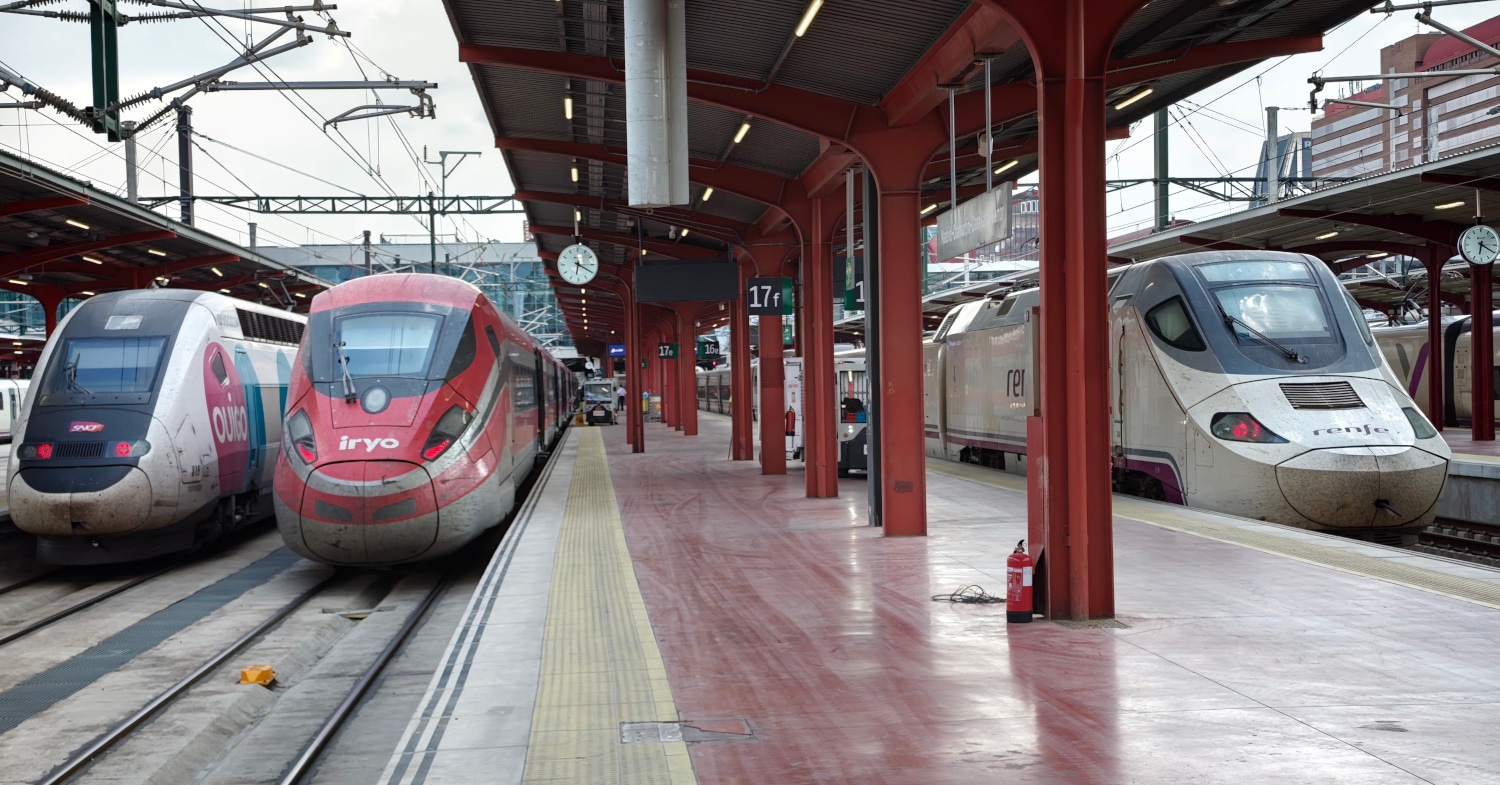
The union mobilisation over railway safety has taken a further step, extending to Renfe’s competitors in high-speed services. CCOO has extended the strike planned for 17 November at Adif and Renfe to the workforces of Iryo and Ouigo, while Semaf has called out drivers at eight companies in the sector. Meanwhile, the Railway Operations Union (SCF) has called a two-day strike on 17 and 19 November.
The 24-hour stoppage coincides with the joint strike called by the General Works Councils of Adif and Renfe. At Adif, CCOO, UGT, CGT, the Railway Union (SF) and the Railway Operations Union (SCF) are taking part, while at Renfe they are joined by the union sections and Semaf.

Demands after Urda
The trigger for the industrial unrest is the accident that occurred on 28 October at Urda, in Toledo, which left 69 dead and forced the temporary closure of the Madrid–Andalusia high-speed corridor. The unions are calling for the review and implementation of extraordinary safety measures, as well as a change of model based on prevention, the human factor and organisational responsibility.
Renfe’s General Works Council maintains that the accident highlights the inherent risks of railway operations, both for staff involved in the safety of train movements and for other workers and passengers. The organisation also calls for a genuine culture of safety and prevention throughout the system.
Semaf calls out eight operators
The Spanish Railway Drivers’ Union, Semaf, has registered its own call for strike action on 17 November, covering drivers at Renfe, Iryo, Ouigo, Transfesa, Continental Rail, Tracción Rail, Captrain and Medway. The rail strike will therefore affect both public and private companies, including high-speed passenger operators and several freight companies.
Semaf general secretary Diego Martín has argued that safety must take precedence over any operator’s commercial and operational interests. After meeting with First Deputy Prime Minister Carlos Cuerpo, who temporarily assumed the Transport portfolio following Óscar Puente’s resignation, the union called for concrete, cross-cutting measures to change how the sector operates.
Semaf considers that the measures announced by the Council of Ministers on 3 November were not agreed with the sector. The union insists on restoring proposals put forward by workers over the years, and maintains that, although structural problems cannot be resolved in fifteen days, it is possible to lay the foundations to address them.
Timetable and union unity
The 17 November strike will be preceded on 16 November by a rally outside the Congress of Deputies. The following day, Adif’s General Works Council will meet again to assess the situation and consider further action, according to the Railway Operations Union.
ALFERRO has decided to move its strike days planned for 10 and 12 November to the 17th, aiming to promote a joint mobilisation across the sector and avoid unnecessary legal risks. The union also alleges that Renfe has questioned the legality of its original strike call and has issued individual warnings to members of its Strike Committee, an action it firmly rejects.
For now, Semaf is maintaining its stoppages at the Renfe Group on 10 and 12 November, in addition to the sector-wide call on the 17th. The first meeting with the new Transport minister produced no progress, and the ministry has summoned the union again today, 6 November.
The extension of the rail strike to Iryo and Ouigo creates an unusually sector-wide mobilisation, with Adif, Renfe, private high-speed operators and freight companies all called out on the same day. The protest focuses on shared demands: safety guarantees, more resources, and structural change in the organisation of Spain’s railways following the tragedy at Urda.