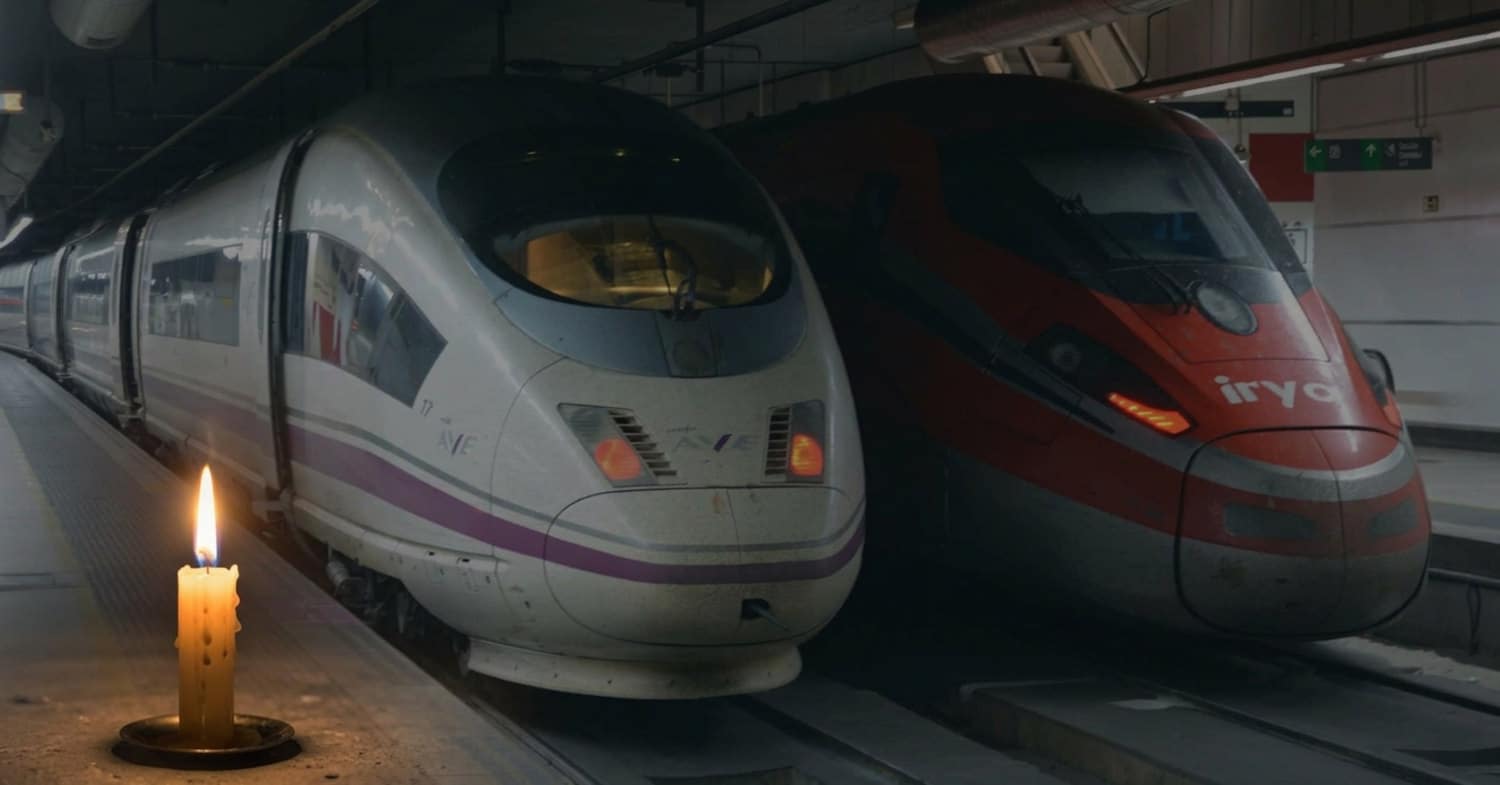
Today, 28 November 2026, marks one month since the Urda accident in Toledo, Spain’s worst rail tragedy since the Angrois accident in 2013. An event that, hopefully, will never happen again.
Railin remembers the 69 people who lost their lives, their families and the injured, particularly those who remain in hospital.

For them, for those who died in other rail accidents, such as Adamuz, and for those who will live with the consequences of these tragedies for the rest of their lives, we call on all political parties to ensure that spending on maintenance and safety is never again reduced, and even less so spending on staff.
In this article, we can only recall the events, discuss the investigation and outline the short-term consequences.
The events
On Wednesday 28 October at 08:53, Renfe AVE 2080 ran into the rear of Iryo 6076. The collision occurred at kilometre 118+800 on track 2 of the Madrid–Seville high-speed line, at the entrance to Urda station. The Iryo was standing at entry signal E242. AITAT estimates that the impact occurred at between 160 and 200 km/h. The exact speed will be known once the judicial recorder data are published.
There were 147 passengers and five crew members on board the Iryo. The AVE carried 379 passengers and seven crew members. As seen in the images we chose not to republish, the AVE’s lead car, a Class 103 train, became embedded in the rear car of the Iryo. Both vehicles overturned at the foot of the embankment, and the remainder of the AVE derailed completely.
The investigation
AITAT’s first information note, dated 29 October, places the origin in an LZB system failure at 08:31. From that moment, trains operated under Lateral Signalling Block (BSL), with instructions exchanged by telephone between the traffic controller at the CRC and the drivers. According to AITAT, the chain of failures, instructions and actions led to the collision without the necessary mitigating barriers being activated. The body stresses that all hypotheses remain open and that its investigation does not determine blame. The final report is expected, in principle, within a year.
All indications suggest the two trains came to a stop in the same physical block section, meaning the protocol required operation at restricted speed. As has been revealed, normal running was authorised. The Iryo train’s delay in resetting its systems and resuming its journey was the final link in this fatal chain of events. As always, many factors contribute to an accident.
On 8 November, AITAT recommended temporarily introducing “restricted-speed operation” at high speed when incidents require alternative safety systems, in what is known as degraded mode.
Consequences
- Political: Óscar Puente resigned on 3 November, and Carlos Cuerpo took over the Transport portfolio. Luis Pedro Marco de la Peña stepped down as Adif chairman and Álvaro Fernández Heredia was dismissed.
- Measures: The Government mobilised €30 million and approved a plan to reinforce high-speed safety.
- Labour: Traffic controllers are demanding more staff and resources. SCF called strikes on 17 and 19 November. The 17 November strike was sector-wide, with all unions staging a stoppage to demand improved safety.
- Operational: The Madrid–Seville high-speed line remains closed, with no reopening date announced. Ouigo has announced ticket cancellations until 15 December.
Judicial: The Orgaz Court of First Instance is conducting the investigation. The Civil Guard is safeguarding the recorders.
Support for victims: The funeral for the 69 victims was held on 10 November at Toledo Cathedral. The Data Integration Centre closed on 17 November, after identifying and handing over the bodies of all 69 victims to their families.
Hospitalised injured
The latest figure available is from 19 November. On that day, Gaceta Médica informed that 22 patients remained hospitalised, one of them in intensive care. They are distributed across two autonomous communities:
- Castilla-La Mancha: five patients hospitalised, all in general wards, according to figures from 18 November. Of the 110 patients requiring admission, 105 had been discharged.
- Community of Madrid: 17 patients hospitalised, one in the ICU at Ramón y Cajal hospital.
Gaceta Médica warns that the death toll cannot be considered final while patients remain in hospital.
From these pages, we wish all survivors and those who have lost a loved one a speedy recovery and hope they can resume their lives as soon as possible.