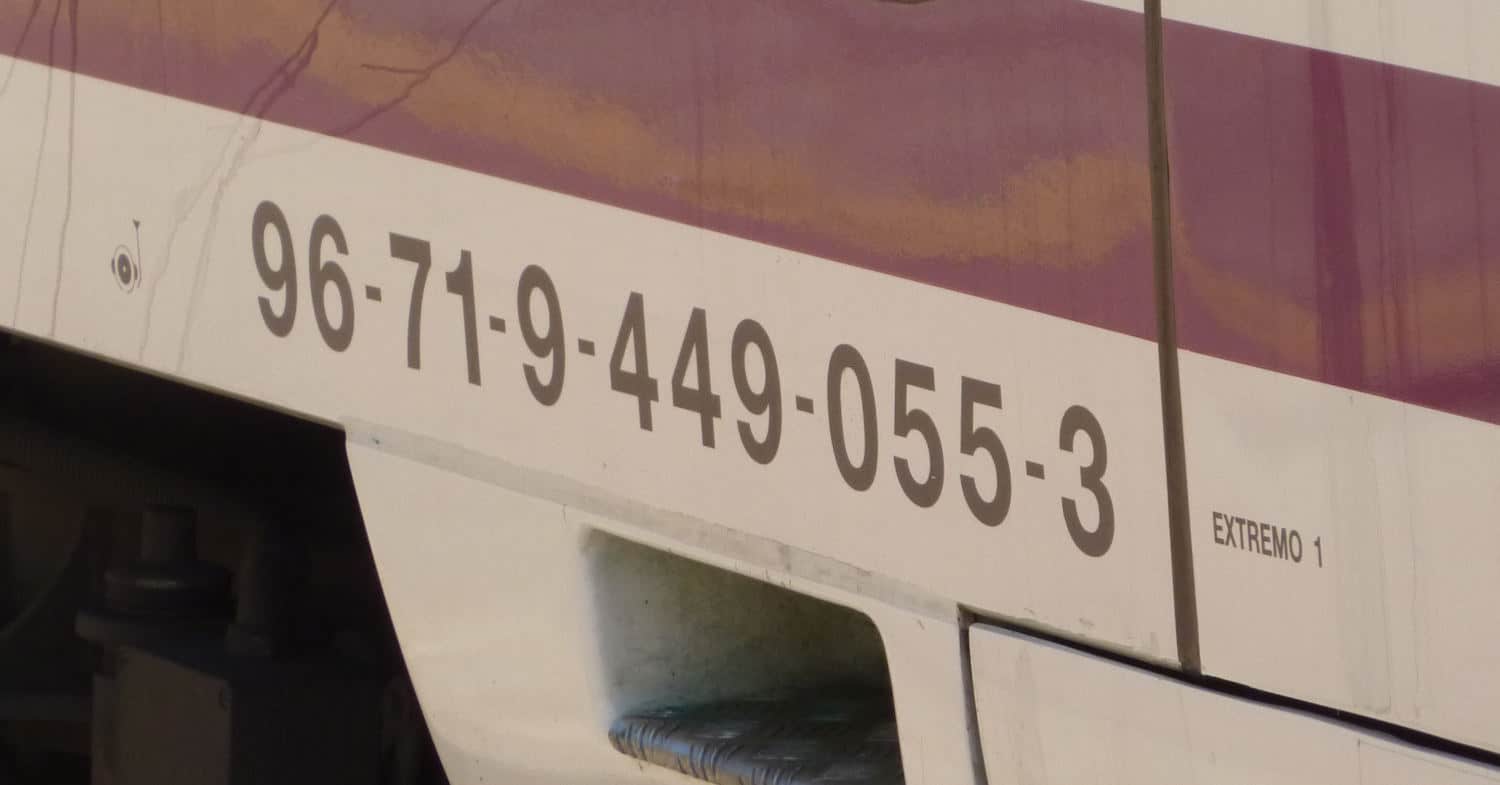
The Spanish Railway Safety Agency (AESF) has published Resolution 8/2026 on national criteria for the numbering of railway vehicles. The document updates the system for assigning the European Vehicle Number (EVN) and incorporates the criteria for the Historic Vehicle Number (HVN), provided for in the rules governing the operation of heritage trains approved in April.
The resolution, dated October 2026 and signed by AESF director Pedro M. Lekuona García, repeals and replaces Resolution 1/2019, which excluded heritage vehicles from its scope. Its criteria apply to vehicles receiving a first authorisation, vehicles manufactured in accordance with a type, and existing vehicles requiring a new EVN.

The Agency clarifies that the document is guidance only: it does not replace the reference legislation nor guarantee that a specific number requested by an applicant will be granted. It also provides that numbering assigned under previous regulations may be retained where adaptation to the new regulatory framework is not necessary.
A twelve-digit number
The EVN retains its twelve-digit structure, in accordance with Commission Implementing Decision (EU) 2018/1614. The first two digits identify the vehicle category and, where applicable, its interoperability capability; the third and fourth indicate the country of registration, which in Spain is code 71. The remaining positions cover technical characteristics, series identification and sequential numbering, while the final digit is the check digit.
For locomotives and self-propelled units, the first digit of the European Vehicle Number is a 9. The second digit distinguishes the following categories:
- 0: miscellaneous
- 1: electric locomotive
- 2: diesel locomotive
- 3: high-speed electric multiple unit
- 4: conventional electric multiple unit
- 5: conventional diesel multiple unit
- 6: special trailer
- 7: vehicle classified as historic
- 8: shunting locomotive or shunting tractor
For the purposes of this second digit, dual-mode or hybrid locomotives are treated as electric. Dual-mode, hybrid or alternatively powered electric multiple units are likewise included in the corresponding electric categories. Shunting tractors form a single category, irrespective of their traction type.
How locomotives are numbered
For locomotives, including shunting locomotives, the fifth digit identifies track gauge and traction characteristics. The criteria distinguish between 1,668 mm gauge, 1,435 mm gauge, multiple gauges and metre gauge, as well as between diesel locomotives and electric or dual-mode locomotives, single-voltage or multi-voltage. Digit 8 is reserved for future requirements.
The resolution introduces two relevant clarifications. A locomotive is only considered multi-voltage if it can operate under the different voltages present on the General Interest Railway Network (RFIG). For example, a locomotive cleared for 3 kV and 1.5 kV DC is classified as single-voltage if the latter voltage does not exist on the RFIG when its EVN is issued.
In addition, the multiple-gauge category is not limited to automatic gauge changing: it also covers locomotives capable of changing gauge through the replacement of bogies or axles in a workshop. Vehicles designed to accommodate several gauges are included even if they are not yet authorised for all of them, but not those that would require redesign to operate on another gauge.
Positions six to eight identify the series: 2XX for electric locomotives, 3XX for diesel locomotives and 6XX for hybrid, dual-mode or alternatively powered locomotives. The following three digits correspond to the locomotive number within its series. A specific ninth digit may be requested to distinguish sub-series or production batches. Where a locomotive consists of several permanently coupled vehicles, each will receive its own number.
Multiple units: vehicle type, series and unit
For multiple units, the fifth digit identifies the vehicle type within the formation. Its meaning will be specific to each series, given the diversity of configurations: motor cars or trailers, end or intermediate vehicles, with or without pantograph, and driving trailers, among other possibilities. Vehicles that are structurally identical and have the same performance and equipment are considered to be of the same type.
Types will be numbered sequentially from the first end of the unit, which will be the end closest to the higher-class vehicles where several classes exist. Zero is reserved for driving trailers.
The three series digits are allocated as follows:
| Series | Type of multiple-unit vehicle |
|---|---|
| 1XX | High-speed electric |
| 4XX | Conventional electric |
| 5XX | Diesel |
| 7XX | Hybrid, dual-mode or alternatively powered |
| 8XX | Reserved for future requirements (currently used for tram-trains) |
The ninth digit identifies the sequence of vehicles of the same type within the unit, beginning at zero, although it may also be requested to distinguish sub-series or production batches. The tenth and eleventh positions indicate the unit number, allowing up to 99 units of the same series to be identified.
The resolution also reserves the ending 999 for spare vehicles: driving trailers or other vehicles that can replace, in a workshop, those assigned to a unit because of failure, maintenance, availability or other reasons.
EVN for wagons, coaches and ancillary rolling stock
For freight wagons and hauled passenger coaches, the AESF establishes no additional national criteria, as European legislation defines the meaning of all EVN positions. Both retain the format XX 71 XXXX XXX-X when registered in Spain.
Special vehicles and ancillary rolling stock use the structure 99 71 9XXX XXX-X. The sixth digit classifies their operating conditions: speed, ability to move under their own power, possibility of being incorporated into a train and other restrictions. It also distinguishes certain cases of bi-modal vehicles.
The seventh and eighth digits identify the machine’s function. The document reproduces a classification covering infrastructure and permanent-way works, track, overhead line equipment, structures, loading and transport, measurement, emergency response, traction and power supply, environment and bi-modal vehicles. It includes, among other equipment, tamping machines, stabilisers, rail-grinding machines, track-recording vehicles, emergency cranes and snowploughs.
Given the heterogeneity of this equipment, the AESF will assess each application individually. Where a special vehicle consists of a formation of several vehicles, a single EVN will be assigned to the complete formation.
Heritage vehicles to carry the 97 71 prefix
The incorporation of the Historic Vehicle Number is one of the main innovations of the resolution. This identifier will comprise twelve digits and will be used as the European Vehicle Number for registration purposes, under Order TRM/367/2026 on the operation of heritage trains. The criteria will apply to HVNs assigned by the Agency from the publication of the resolution.
All will begin with 97 71: 97 identifies their classification as historic and 71 corresponds to Spanish registration. The fifth digit will distinguish the type of vehicle:
| Fifth digit | Type of historic vehicle |
|---|
| Fifth digit | Type of historic vehicle |
|---|---|
| 0 | Hauled passenger coach |
| 1 | Steam locomotive |
| 2 | Locomotive |
| 3 | Multiple unit |
| 7 | Wagon |
| 8 | Special vehicle |
| 9 | Other |
Positions six to eight will allow information on the identity of the vehicle to be retained. For locomotives and multiple units, the former series will be used wherever possible. For coaches, the first three digits of the numbering that identified their type will also be used where possible; for wagons, the numbering used to identify the type will be used. Special vehicles and other cases will be assessed individually.
For steam locomotives, these three EVN positions will express the wheel arrangement through the number of leading carrying axles, driving axles and trailing carrying axles respectively. Positions nine to eleven will contain the sequential number, although for locomotives and multiple units it will be possible to retain the vehicle number within its series. The final digit will be the check digit. Where historic vehicles form a formation of several vehicles, a single number will be assigned to the complete formation.
The AESF justifies the new scheme by the incompatibility of the historically used criteria with the digits required by European legislation and by the risk of duplication with EVNs assigned to other vehicles. The heritage train order nevertheless allows the former number to continue to be displayed on the sides of vehicles, in smaller characters than the HVN, to aid recognition and traceability.