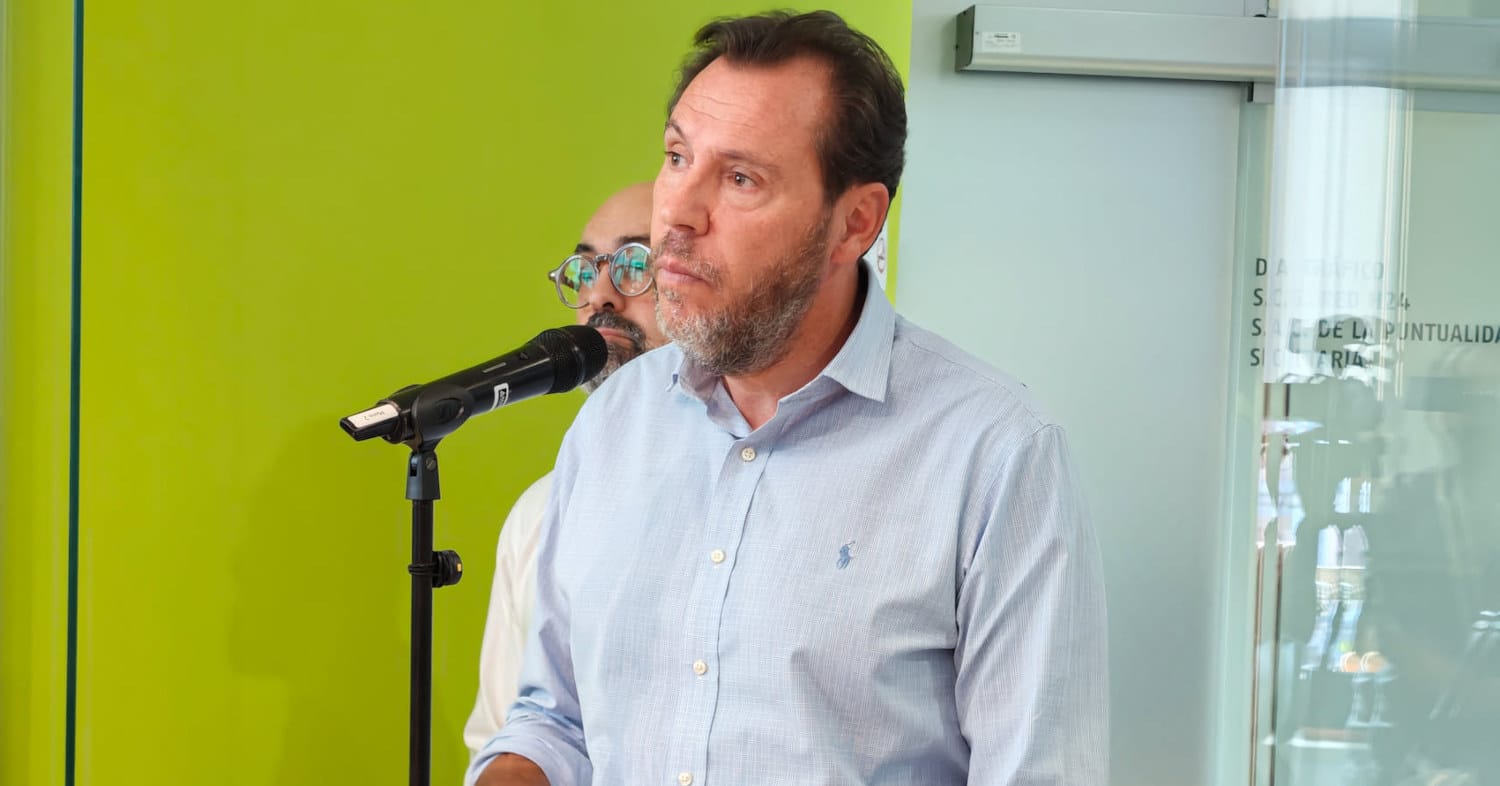
The Spanish Transport minister Óscar Puente explained from Adif’s H24 control centre at Atocha how this morning’s accident occurred on the Madrid–Sevilla high-speed line.
The minister confined his remarks to an account of the facts and avoided attributing responsibility, which will be for the investigation to determine. The times he gave are approximate.

Rear-end collision after safety system failure
At 08:53, a Renfe train struck an Iryo high-speed train standing on the track at the entrance to Urda PAET (train overtaking and stabling siding) in Toledo. On the information available to him, Puente put the toll at 64 dead and more than 50 injured, referring to the emergency services for final figures. At the time of publication, the death toll stood at 68.
The sequence of events
- At around 08:30, the LZB train protection system failed owing to a communication fault between three network computers.
- A section of roughly 63 km was left without LZB. Puente also mentioned 69 km at another point.
- All trains in the section came to a stand automatically. Six would appear to be involved, although the minister did not regard the figure as final.
- Adif’s Atocha control centre took charge of operations and established contact with the stranded trains.
- At around 08:36, the control centre authorised the Renfe train to resume normal running.
- That train had an M zero — a mandatory stop. Ahead of it was another train standing in the same block section, with the signal at danger.
- According to Puente, Adif’s rules and protocols required, at most, movement at restricted speed, with a maximum of 40 km/h.
- Between 08:36 and 08:53, the train covered some 25 km in 15 to 17 minutes. Its speed is unknown, but it may have reached 200 km/h.
- The control centre had ample time to detect the error and did not correct it, according to Puente.
- At 08:53 the rear-end collision occurred at the entrance to the station. Visibility was poor, which limited the driver’s reaction time.
What happened to the other trains?
According to the minister, the remaining trains were also instructed to resume running. In one case, the driver challenged the controller, who corrected the instruction and ordered movement at restricted speed. Puente believes the train that was struck received an instruction to resume running when the other train was already moving, but said he did not know why it had not done so.
The controller at the control centre is experienced. An assistant was assigned when the events occurred, and a supervisor was also present. Puente has not spoken to him.
LZB and safety
The LZB failure was an IT fault that can occur, although not frequently. The system has been in service on the line since 1992 and is being replaced by ERTMS because it is no longer manufactured. Adif and operators have protocols for dealing with this situation if the safety systems do not return to service.
Puente located the cause of the accident in the control centre’s decision, which he described as “inexplicable”, rather than in the IT failure. He maintained that the Spanish railway system is safe and comparable with those of neighbouring countries.
On his own future, he replied that he was not thinking about himself. He added that he had spoken with the prime minister, who will travel to the scene of the accident, and that he would appear before parliament as often as necessary.