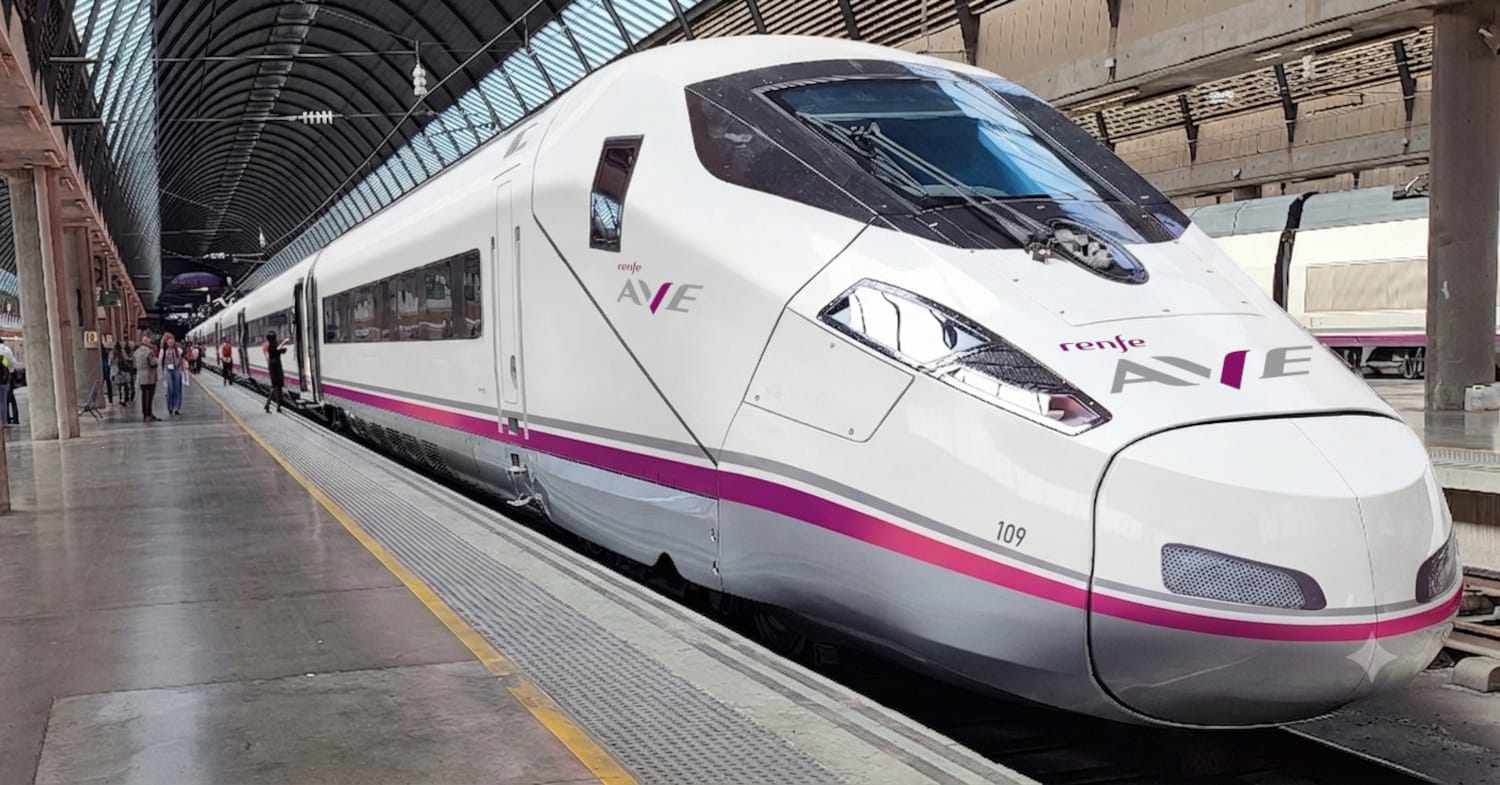
The tender for the manufacture and maintenance of 30 high-speed trains for Renfe is continuing despite the snap election announced by Prime Minister Pedro Sánchez. Renfe has confirmed to Railin that the process is proceeding, with some sources indicating that the award could be made at the board meeting in the last week of October.
Why the election does not affect the tender
The tender does not depend on the political calendar. It is a procurement procedure launched by Renfe Operadora on 1 April. Although the Parliament has been dissolved and elections called for 29 November, the Government remains in office until the polls are held, in accordance with Article 21 of the Government Act.

Until then, it retains full powers, meaning the award planned for late October is not subject to the restrictions that apply to a caretaker government. Moreover, the Organic Law on the General Electoral Regime (LOREG) does not prohibit public procurement during the electoral period: its restrictions concern institutional advertising, events that highlight government achievements, and the inauguration of works or services. The LOREG therefore does not prevent the contract from being awarded, although it does limit how the result can be communicated to avoid turning it into a propaganda event.
Far from slowing the process, the snap election has accelerated the timetable. Renfe and the Ministry of Transport want the award to be made before campaigning begins on 13 November. The need for new trains cannot be deferred either. Renfe must expand its fleet to meet growing demand and compete with Ouigo and Iryo. It also needs to offset the reliability problems of the Series 106 and its lack of certification in France, as well as manage the withdrawal of the Series 100, which has been in service for 34 years.
A non-binding motion
On 29 September, the Congress Transport Committee approved a non-legislative motion tabled by the Partido Popular. It passed with the votes of the PP, Vox and ERC, while PSOE and Sumar voted against, and Junts and the BNG abstained. The motion calls for the technical, authorisation and delivery requirements to be reformulated, and for a new tender to be considered if legal grounds exist. Its aim is to favour manufacturers with factories in Spain, which have been excluded from the competition.
However, a non-legislative motion is not binding. The resolution has no direct legal effect on the procurement procedure, even though it makes Congress’s position clear. The parties supporting the Government voted against it, and Cinco Días confirms that Renfe will press ahead despite the initiative.
The PP argues that the specification favours Hitachi. It questions the requirement for a design capable of 350 km/h in commercial service and of 1,080 mm between vehicle bodies. Renfe maintains that this speed will allow journey times to be reduced as infrastructure improves. Neither CAF nor Talgo currently has a train designed for that speed, whereas Hitachi and Siemens both have such trains in production, and Siemens already has the Series 103 authorised for that speed. Talgo, moreover, submitted its bid late, while Alstom did not take part.
The Hitachi and Siemens bids
The initial order is for 30 trains worth €1,362 million, with an option for a further 10 units, taking the value to €1,777 million. Including maintenance and spare parts, the contract could reach €4,145 million. The first five units, already authorised, must be delivered within a maximum of 40 months, with the full order due within 78 months.
Hitachi Rail is the frontrunner with the ETR 1000, the same train operated by Trenitalia and Iryo as the Frecciarossa 1000. It is not known whether it offered the first-generation version, similar to Iryo’s Series 109, or the second generation already in service in Italy. The latter replaces the technology Alstom did not transfer with Hitachi’s own components, and incorporates improvements in energy efficiency, comfort and interior design.
Siemens Mobility had considered offering the Velaro Novo, designed for 360 km/h in commercial service. However, only one trailer vehicle exists for authorisation purposes, which reached 405 km/h. It is a project with no orders in Europe and no production line. To meet the deadline, the most viable option would be to offer the Velaro MS (Deutsche Bahn’s ICE 3 neo or Class 408), which is already in service in Germany, Belgium and the Netherlands, and is being authorised in France and Poland.
A constraint for both manufacturers is the ability to test at 385 km/h, the speed required to authorise a train for 350 km/h operation. The condition of the Madrid–Barcelona high-speed line makes this difficult, although its comprehensive renewal will begin with the Madrid–Calatayud section, where speeds in excess of 400 km/h have been achieved with a Series 103 train.