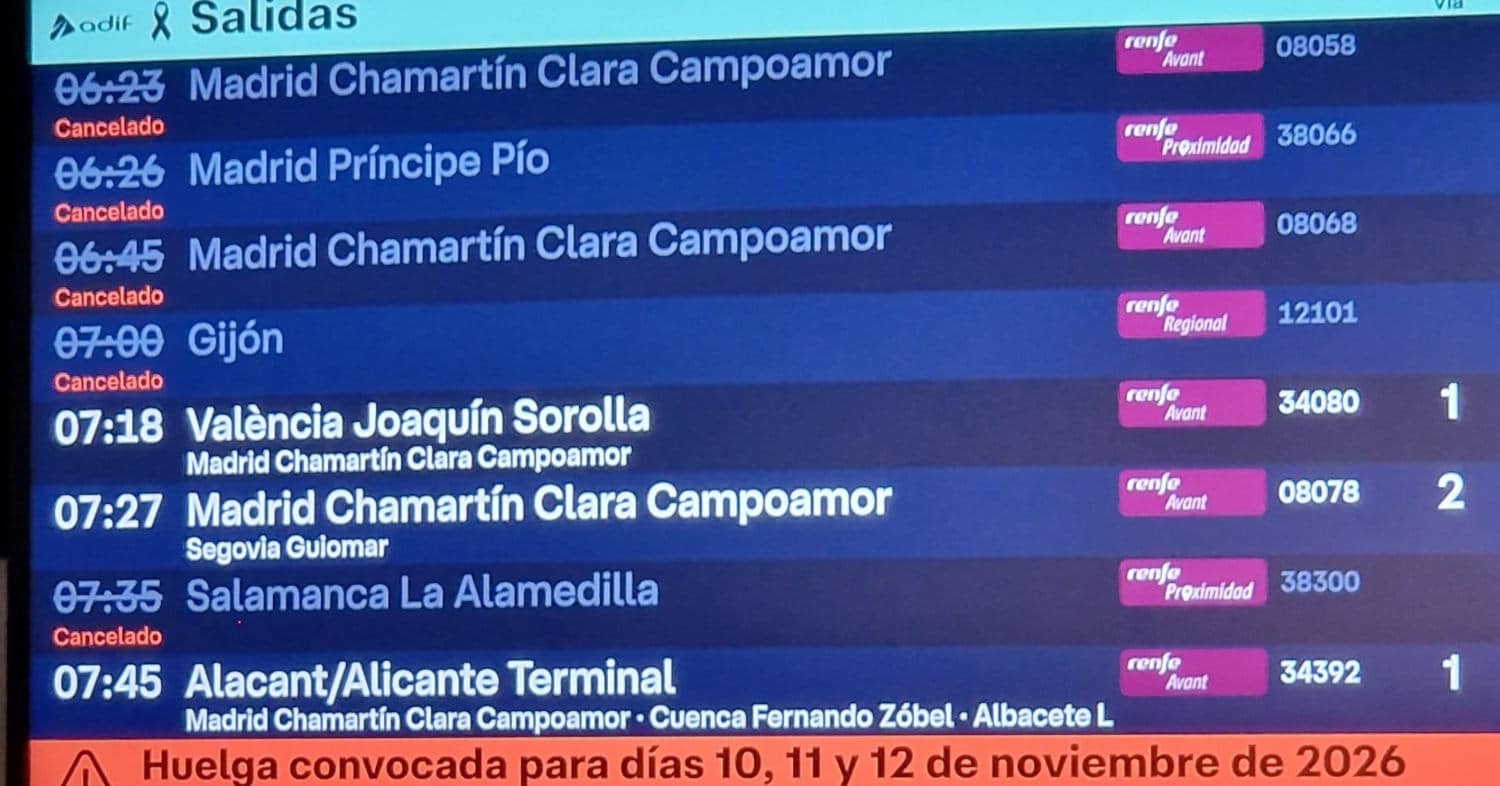
The train drivers’ strike called by Semaf began on Tuesday, 10 November, with significant breaches of minimum service requirements, particularly on Cercanías Madrid and Rodalies de Barcelona. The causes are the subject of conflicting accounts between Renfe and the union, and centre on the designation letters and the notice periods with which they were issued.
What happened in Cercanías Madrid
According to the latest statement, services are not operating on lines C-1, C-2, C-3, C-4, C-5 and C-8 of Cercanías Madrid. Only a limited number of trains are running exceptionally on lines C-7 and C-10. The situation is similar to that seen during the strike on 29 November.

The Ministry of Transport set minimum services for Cercanías at 75% of services in peak hours and 50% for the rest of the day.
According to Renfe, 89.57% of the trains scheduled as minimum service have been cancelled, while a further 5.21% did not depart. Across all Public Services, 32.21% of minimum services have been cancelled, and 25.68% did not depart. Strike participation among workers able to take part is 19.64% when night and morning shifts are combined.
Renfe’s version
Renfe attributes the non-compliance to drivers refusing to receive the minimum service designation letters. The company says it sends them through corporate email, certified digital communication via the lleida.net platform, push notifications on tablets as soon as they are switched on, and by hand.
According to the company, the Professional Development Agreement requires drivers to accept notifications electronically. Renfe maintains that everyone was notified through this channel, but alleges that some drivers do not open either the email or the Lleida platform. It adds that Semaf considers only hand delivery to be valid.
Renfe explains that hand delivery is complicated by the four-days-on, three-days-off shift pattern, and even more so if the resolution is issued with less than three days’ notice and there are public holidays in between.
José Antonio Santano signed the minimum service order on Friday 6 November at 18:18, leaving little time to establish and communicate it. This is compounded by the weekend, as yesterday was a public holiday in the municipality of Madrid and some drivers have been off duty since the order was signed.
The operator says middle managers attend the start or end of the train’s duty, yet in many cases drivers still do not collect the letter. According to the company, all letters have been delivered except at the Fuencarral and Atocha depots, where it alleges “abusive practices” to prevent delivery.
The drivers’ version
For their part, drivers maintain that every worker who received the minimum service letter has reported for duty. They attribute the disruptions to Renfe management errors and continue to insist on hand delivery of the letter.
Some drivers consulted by this publication say that Semaf advises them not to accept electronic communication, invoking the right to digital disconnection.
Others claim they received the minimum service letter less than 96 hours in advance, meaning it is as if they had not received it at all.
The 96-hour rule and the legal framework
The minimum service order was issued on 6 November at 18:00, approximately 78 hours before the start of the strike. This is less than the 96 hours that, according to the internal regulations governing duty rosters, apply to communicating shift changes.
The strike law does not require the Ministry to issue the resolution 96 hours in advance. The company is responsible for designating each driver and must communicate it individually, formally, and in advance.
The 96-hour notice period is enforceable when the designation involves a change to the shift, duty roster, or working conditions set out in the collective agreement. In that case, Renfe must give the worker that notice because the change affects their working hours, handovers, and ability to organise their personal and working life; the collective agreement sets this notice period to ensure the change is not improvised.
If Renfe had to reorganise shifts or duty rosters to comply with the percentages set, it had less time than the 96-hour clause required. This circumstance may support Semaf’s claim regarding the method of communication, but it does not, by itself, invalidate the minimum service resolution or exempt a worker who has been properly designated from attending work.
Case law requires the company to prove that such communication took place, and the Lleida.net platform meets that objective if the reading is signed. It should not be assumed that only hand delivery is valid: an electronic means can be valid if it is individual and given in advance.
The dispute centres on whether the Professional Development Agreement supports electronic notification and whether Renfe can prove that drivers, who have the right to digital disconnection under the collective agreement, received it. That question remains unresolved. If the designation was not valid, non-compliance cannot be attributed to someone who was not properly designated.
The strike continues on Thursday 12 with partial stoppages: from 06:20 to 09:20, from 14:20 to 17:20 and from 21:20 to 23:20.